4 Reasons I Don’t Believe in Destiny
Destiny.
It’s been on the lips of game retailers and gaming journalists for the past two years. After the Halo franchise, Bungie Entertainment split from Microsoft Studios and set off on an intergalactic course that would take them to this game’s September release. This is going to be the video game release of the fall season on next-generation consoles. Crafted by the original creators of Halo, one of recent history’s most popular games, co-created by Activision, who’s responsible for the bestselling Call of Duty franchise, this game will be nothing short of revolutionary.
I wrote this because this isn’t the first time the gaming industry has brought such hype to a major release. Video games are a nearly $70 billion-a-year industry, and fortunes are at stake during this fall gaming season. Make no mistake, lines will form at stores when the game comes out, and reviewers will gush about how amazing it is. I, however, am jaded. I’ll be waiting at home when this game is released, with no intention whatsoever of buying it until I hear a word-of-mouth review. Here’s why:
1. Don’t believe the hype.
Let’s say that you work for a video game review website, and you’ve been invited to E3. First, let me say congratulations on your success, and I’m insanely jealous of you right now.
You’re invited into a room to test an early version of the latest, most anticipated game that will be on shelves in a matter of months. You’re dropped into the game without any buildup, a developer stands nearby while you play a set course through a single, finely-tuned section of the incomplete product. With impressive cinematics, gorgeous effects and fine-tuned gameplay, you walk away with a spring in your step and a song in your heart as you go off to write a glowing article about the experience.
IGN got the chance this month to play a portion of Destiny for a preview article, and this was the result:
You play a bit of the game, you get to see the best completed portion of it, and it leaves you with an impression that the rest of the game will be just as good. In Destiny’s defence, the graphics look incredible. It takes advantage of everything next generation consoles and graphics cards have to offer. But what do we really know about this game? You see three minutes of gameplay and a handful of generic enemies.
You have to remember that this game isn’t finished. In the next several months, parts of it will be polished, modified, and entirely altered. Sometimes playing these games before their release is like having a slice of pie and knowing that the rest of the pie is just as tasty. And sometimes, it’s like wearing a blindfold and licking the bread on a turd sandwich:
Aliens: Colonial Marines was one of the most anticipated games of 2012. A multiplayer adventure, taking place in the Aliens universe, featuring the titular characters in a fight for their very survival. ACM spent two years in development, building hype that it simply couldn’t live up to. And when I say that, I mean it didn’t even try.
When it was released in early 2013, ACM became one of the most reviled games in history. ACM’s failure was like another alien-centric game: Atari’s ET. The difference was that ACM had better graphics, more funding, more advertisement and a premise that could absolutely work in a video game, based in a franchise that already had a massive fanbase. SEGA shouldn’t have been able to fuck this up if every character’s dialogue was voiced by Mickey Mouse.

It was referred to as a “bait-and-switch” by Gamesradar.com, and the game was so flawed, so abysmal, so incredibly awful, that consumer groups sued SEGA for false advertisement on the accusation that the gameplay was nothing like that presented in its trailers or its initial gameplay previews.
Positive preliminary reviews are, in themselves, a form of advertisement; and video game advertising is projected to become a $2 billion-a-year industry by 2016. It wouldn’t be fair to suggest that game review sites give positive reviews in exchange for money, but…
2. Don’t believe the reviews
…Sometimes, they absolutely do.
Like any website, the owners of game-reporting sites receive money from advertising revenue. Because of their context, the majority of the revenue on such sites comes from video game companies. You can see where I’m going with this: Popular websites like Gamesradar, GameSpot and IGN write video game reviews. Video game companies pay these publications for advertising space for their games, which will be inevitably reviewed by those same publications. There’s no way of knowing yet whether Destiny will be good or bad, but reviews are often just a cog in a developer’s hype machine.
If your television station showed adverts from a beef manufacturer, and reporters for that station’s news program discovered that a growth hormone used by that manufacturer caused cancer, what would happen? Would the station pull the ads? Or would it pull the reporters? I’m not saying that video games will give you cancer (seriously, Aliens: Colonial Marines absolutely will give you cancer), but gaming publications often find themselves in a similar situation.
Jeff Gerstmann, former editorial director at Gamespot.com learned this the hard way when he was tasked to review the 2007 release, Kane & Lynch. The game was an action-shooter about a pair of gunslinging desperadoes who go on a crime spree to get the ransom money they need to save one of the main character’s daughter, who was kidnapped by–actually, it doesn’t matter. If you haven’t heard of it, it’s because it’s not one of the great games of the past decade. And if you have heard of it, it’s probably because of Gerstmann.

Eidos Entertainment apparently believed that they were buying a publicity package when they paid to advertise the game on Gamespot, because when Gerstmann wrote a poor review of the game, the company threatened to pull all of its advertising from the site. In a bold stance, Gamespot stood by its reporter and commended him for his journalistic integrity.
Haha, just kidding. They sacked Gerstmann and canned his review. The act cast a shadow over video game journalism for years afterward, and although Gamespot eventually hired Gerstmann back, he didn’t stay.
Advertising revenue is an incentive for gaming journalism outlets to write favourable reviews, but it’s not the only reason. Gamesradar awarded 5-star reviews to Halo 3, Gears of War, Assassin’s Creed 2 and the Orange Box, all of which I think stand as classics for this generation. Each of those games brought something to the industry that had never been tried or accomplished before, or otherwise took a tried-and-true formula and turned it into something extraordinary.
Other games that received Gamesradar’s highest rating, however, include Bulletstorm, Bayonetta, Deus Ex: Human Revolution and Final Fantasy XIII. If you’ve played any of these games, you may notice a slight disconnect here. Bulletstorm, a generic shooter with the twist of giving you an energy grappling hook and letting you kick things really hard. Bayonetta, an arcade-style beat-em-up featuring a sexy leading lady with an assortment of guns to battle demons and angels. Deus Ex: Human Revolution was a current-gen sequel to a well-loved classic, that could be finished in one or two days. Final Fantasy XIII, which took everything that was great about Final Fantasy, filled it with uninteresting stock characters and turned the previously open game world into a series of straight lines.
Bulletstorm, Bayonetta, Deus Ex: Human Evolution and Final Fantasy XIII each have their strong points, but I don’t think that any of them deserve to stand on the same platform, at the same level, as the Orange Box. What do all of these games have in common, however? Their developers paid Gamesradar to fill its site with banner adverts and publicity for weeks before their release dates.
I’m not saying that Gamesradar lacks integrity, or that I can say with absolute certainty that its reporters didn’t think that these games were anything less than five-star games when they were reviewed. When you come right down to it, a review is just an opinion piece. What’s good for one gamer might be rubbish to another, because…
3. There’s no fixed standard for game quality
…What is good, really?
Destiny is going to be great. We know this because the Internet says so. But why is it going to be great? It’s made by Bungie, who developed Halo, which stands as Microsoft Studio’s most iconic title to date. And it’s spent the past two years in development, awaiting what is certain to be a sell-out release date. Halo was a good, solid, wonderful game that redefined the entire FPS genre: But that doesn’t mean that Destiny will be good, or even better than Halo, simply because it’s made by the same developers.
Do you know who else designed and funded Destiny? Activision, to the tune of approximately $500 million. Activision, who’s responsible for Call of Duty. A lot of people like the Call of Duty franchise, even though its campaigns can be played through in a single afternoon, single-player is limited, and most of the players online have claimed to have had sex with my mother. Single-player is the primary reason I play video games. When that’s neglected, as it is in CoD, I simply don’t care about the franchise. I clearly think that Halo was a better game than CoD, but is it fair to make that distinction?
Ice cream is good, but is it as good as a sunset? Is it good in the same way that hugs are good, or taking a hot bath after a long day? Music is good, sunshine is good, but can you compare it to the scent of the air and the sweet smell of grass after it rains? Who decides these things?

Still thinking about how great Halo was…
Game reviewers are just as conflicted. When you rate a game by numbers, or stars or letter-grades, something’s going to be lost in the translation. How do you compare Street Fighter 4 to Gears of War, or Civilisation to Portal? Movies, prose and poetry all have standards: a literature professor can point out everything that makes a work good or bad that consumers might not even have noticed. They rate works based on theme, on story, on symbolism and voice. Game reviews, however, are based on fun.
How much fun will you have playing this game? Sports video games rate high, but I don’t have much fun playing them. Complex War games like the Total War series often rate high, but casual gamers might not have as much fun playing them. Sometimes, when a bad game gets a good review, it’s not a matter of game journalists lying to you for the sake of ad revenue. You’re dealing with the writer’s own perspective. If they have fun with a title, that doesn’t mean that you will too.
This discontinuity leads to another hurdle for game developers and fans alike. Day-one reviews are becoming a thing of the past as reviewers have, with major releases, been legally barred from posting reviews online for the first 48 hours or longer after a game’s release. It happened with recent titles such as Titanfall and Battlefield 4. Both were good shooters, but what happens when the game isn’t good? Who’s going to warn consumers before gaming publishers collect all of the sucker-money on release day?
Metacritic tries to solve this problem by allowing fans to review games on a 10-point scale. If you’ve just paid $60 of your hard-earned money for a video game, and you want to tell the world what you liked or didn’t like about it, now you can:
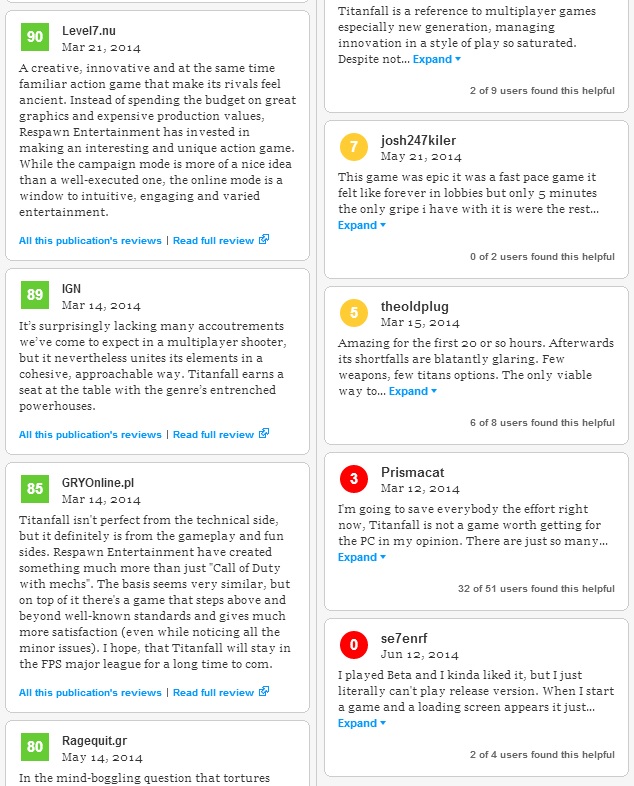
This is a section from the reviews of Titanfall on Metacritic. The column on the left was written by professional critics, while the column on the right was written by gamers. Titanfall received 27 positive reviews, zero negative reviews, and one mixed review from gaming review websites. From private gamers, the game received 200 positive reviews, 69 mixed reviews and 135 negative reviews.
The problem with publications’ reviews is that they can only get past the week-one embargo in terms of giving Metacritic ratings if their metacritic score is above 85. Sometimes, this means inflating scores (on a 100-point scale) higher than a game deserves, or lose hits to their respective websites. The problem with user reviews, however, is that no one can seem to agree on anything.
How good or bad is a game going to be when it comes out? It all comes down to who you believe….
4. I don’t believe in Destiny
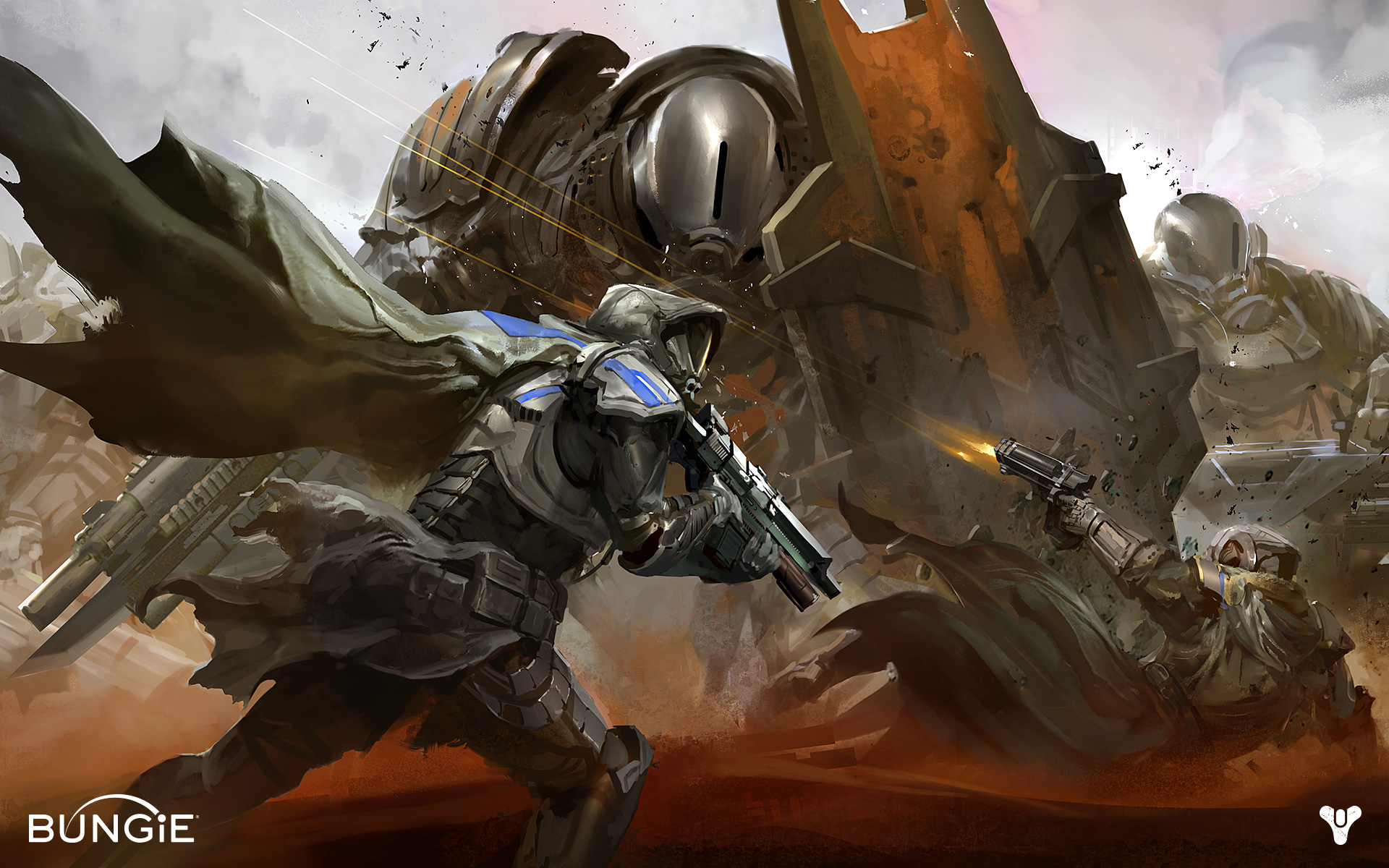
Take cover. This might be the end.
It’s a matter of personal preference, and this is mine. Maybe Destiny will be absolutely magnificent, maybe it’ll be a magnificent disappointment. What do I know about Destiny? I know that it’s going to be an online game. You won’t be the hero of this story, but one of many heroes in a changing world. Bungie says that it’s an MMO, but not an MMO. It’ll be like Borderlands, but bigger than Borderlands.
It’s going to have PVP and coop modes, it will have a central hub where you can meet players from all over the world, and you’ll be able to pick and choose who you want to go on missions with you. You’ll have extensive character-creation options and multiple classes to choose from. It actually sounds a lot like an MMO, but it’s not, according to Bungie.
My problem with MMOs, the reason I’ve lost interest in games such as World of Warcraft, Champions Online and DC Universe Online, is because you’re not the lone hero, or the most important person in the game’s universe. The story doesn’t revolve around you, and your actions do almost nothing to change the game world in one way or another. They take away a bit from the escapism, and nothing kills the illusion and immersion into a game world like other players.
You know the feeling: You’ve just embarked on an epic quest. You have your powers, you have the esteem of your home people. You are the Chosen One. You set out on your first mission with all of the skills and abilities at your disposal, fight the first boss…and then Camelbollocks251 walks up from behind and decapitates you.
But today, all we really know about for certain is that Destiny is very similar to an MMO. The game itself is riding an all-too-familiar wave of hype and heavy advertising with billions of dollars at stake. For all of the E3 publicity it’s had, and the preliminary gameplay that’s been presented, we still know very little. You won’t be able to trust the reviews, and even if you do, which reviews would you trust?
I’m going to wait for the best review outlet in history: Word of mouth.

Posted on June 26, 2014, in Video Games and tagged Activitsion, Aliens: Colonial Marines, Bungie, Destiny. Bookmark the permalink. 6 Comments.

 Henchman-4-Hire
I agree with most of it, especially the hype part, except for small 2 things:
– I don’t like that you put DE:HR in the same category as FFXIII, if the only problem you had with it was that it could be completed in 2 days the same could be said of GoW, and if you actually try to do everything in the game instead of only the main story it lasts a lot more than that, but I understand the point you make in that publicity influences scores, and everybody likes games differently.
– I don’t think Metacritic solves anything, as an example I’m going to put CoD, personally I think they are a 7 at best, but something that I find repulsive in Metacritic is the fact that they let anyone review, that includes people who haven’t bought the game, I saw a review giving one a 0 complaining about how it WON’T do anything new and how the villain WILL PROBABLY be just a russian betrayer, the review was about CoD: Blacks Ops 2, where they introduced decisions that affect the story, a semi “tower defense” game and the villain was a latino with a sympathetic backstory who tries to produce a war between the US and China, they revealed all that before the game came out, couldn’t bother to even do research.
Something similar happened with the new DMC, it wasn’t great (again, 7 at best if I’m feeling generous) but it was certainly better that plenty of games that are nowhere near as hated, and fanboys proceed to give it 0 despite admiting that they didn’t even played it, if you got it and didn’t like it then fine, different strokes for different folks, but what gives someone a right to review something, anything, based on a 10 minute gameplay at best, concept art at worst (not joking).
Personally I think that for a system to actually depend of the players voice it should make it so that only people who have actually bought it to give an opinion on it. Unfortunately that doesn’t solve the problem where a game might have sold more copies at launch than it deserves because no one was allowed to say how bad it was before it comes out.
DE:HR is a fine game. But sadly, me and the franchise have grown apart since the original. I wrote a review for it when it was released, here: https://henchman4hire.com/2011/09/06/the-problem-with-exes/
I loved this game when the news started flowing in about it.
For me personally, character customization is one of the key factors for buying a game, being able to change abilitys, act how i want, dress how I want and Look how I want is very important, especially for a RPG.
I loved how they said you will look completely different to every other player, but then the Alpha footage started coming out and the customization was lacking, VERY lacking. There were about 6 pre-set faces to choose from.
I know it’s only alpha and more will be added, but the game has been in development for 2 years now, how many faces can they add by September?
At least have a slider so I can change around the face a bit. After I saw that, I realized this game won’t be as good as everyone says.
I still believe it will be a fun game, but I’m worried that many people will hate this game at launch as it simply won’t live up to the hype.
Customization is key for me too! It’s one of the reasons I keep buying WWE games after all these years. But all of the character models for Destiny look the same so far. I didn’t even realize it had faces? Really? I thought they were all similar-looking helmets.
Yeah it’s really disappointing that there is very little customization, when that is the big thing they always go on about during their interviews. Even the armors look the same, at least you can change the colours of them i guess.
I haven’t seen any in depth videos or anything about armor customization, but it looks to me like you can maybe change colors, put a doodad here or there, shift some plates around. I dunno. Kind of like Halo multiplayer armors. I guess maybe that’d be interesting, but not very.