Blog Archives
Review: The Weirding Willows
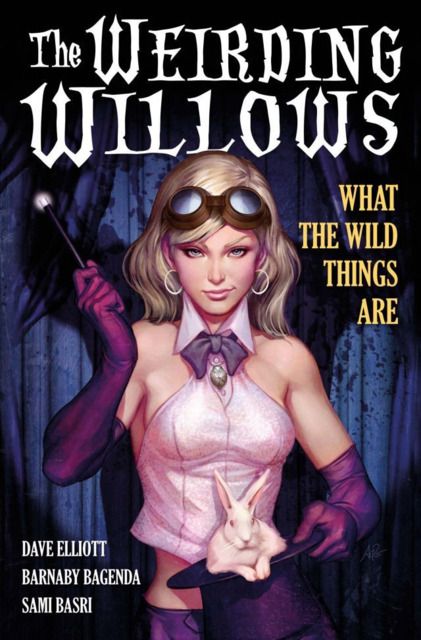
Did you know that Alice from Wonderland was the daughter of Dr. Moreau? Or how about a team up between the Wicked Witch of the West and Dr. Jekyll? And did you ever wonder how Mowgli could speak to the jungle animals? Maybe he was part Doolittle? These are only some of the wickedly inventive crossover tales found in The Weirding Willows, a new graphic novel being released by Titan Comics by writer Dave Elliott. Like The Avengers movie, Alien vs. Predator or even Once Upon a Time, Elliott has written the king of all crossovers starring a wealth of characters from classical 19th century fiction. Alice in Wonderland, The Island of Dr. Moreau, The Wizard of Oz, The Wind in the Willows; even Peter Rabbit makes a guest appearance in this clever comic, the hardcover collection of which is due out July 1.
The first volume of The Weirding Willows seems to be just the tip of the iceberg of this hugely imaginative story. Elliot fills each chapter with cameo after cameo, presenting an intricately woven tapestry of adventure starring some of literature’s most favorite characters.
Comic Rating: 7/10 – Good.
Alice is the star of this series, presented as a no-nonsense teenage girl who has discovered more than just a portal to Wonderland out in the woods surrounding her house. The titular Weirding Willow actually contains portals to all manner of fictional lands, including Oz, Pellucidar (Journey to the Center of the Earth) and NeverNeverLand. But Elliott’s story is not just about doorways to all of these worlds. The characters and creatures of fiction already seem to live in and around the Willows, and many already have a long history of working together. Alice is the daughter of Dr. Philippe Moreau, because why not? It’s not like we ever knew Alice’s last name in the original Wonderland stories (did we?). And Moreau is an old friend of Morty Doolittle, son of the famous doctor (not the Eddie Murphy version). And the Wicked Witch of the West wants both of them to help her build an army of flying monkeys. Moreau’s scientific specialty is making freaky hybrid animal monsters, is it not?
But while that evil is afoot, Alice is tasked with helping the White Rabbit and his bunny friends defeat a monster who has invaded their little bunny homes – Frankenstein’s Monster! Also there’s at least one T-Rex.
Join me after the jump for the full review! And the hardcover is available for pre-order on Amazon.
Review: Marada the She-Wolf
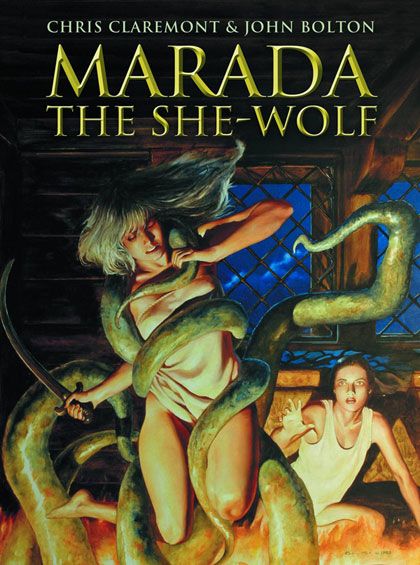
Fans of swords, sorcery and tales of adventure will find a lot to love in the classic comics of Marada the She-Wolf, created by legendary comic book writer Chris Claremont. A serial from the early 1980s, Marada is Claremont and artist John Bolton’s attempt to create a badass, fantasy warrior woman in the vein of Xena or Red Sonja. She’s beautiful, honorable and good with a sword, and a collected edition of of her adventures released this month by Titan Comics goes a long way in establishing her as an exciting action hero – with one major caveat.
Comic Rating: 7/10 – Good.
The collected edition of Marada comics features the complete run of the character across three issues, with a lot of behind-the-scenes materials. The story takes place somewhere in the middle of Marada’s heroic career, since she’s already a well-known character at the start. Unfortunately, for whatever reason, Marada’s adventures did not continue beyond these three issues, so we only really get the first half of her adventure. The rest is lost to posterity. And I found the comic entertaining enough that I wish I could see what happened next.
Marada is a nomadic warrior princess who travels the world having adventures – which, frankly, is my dream job (minus the princess part). She’s the graddaughter of Caesar, and the story is set during the days of the Roman Empire. Marada’s tale takes her to the African Savannah, the Middle East, the high seas and even into demonic dimensions. She’s your typical heroine, and her adventures are resoundingly fun and filled with a great cast of entertaining supporting characters.
The best way to describe the art by Bolton is ‘classic’. This is exactly the kind of painted fantasy art I imagine when I think of tales from this era. All of the characters look like they stepped off the cover of a slightly-less air-brushed romance novels, but in a good way.
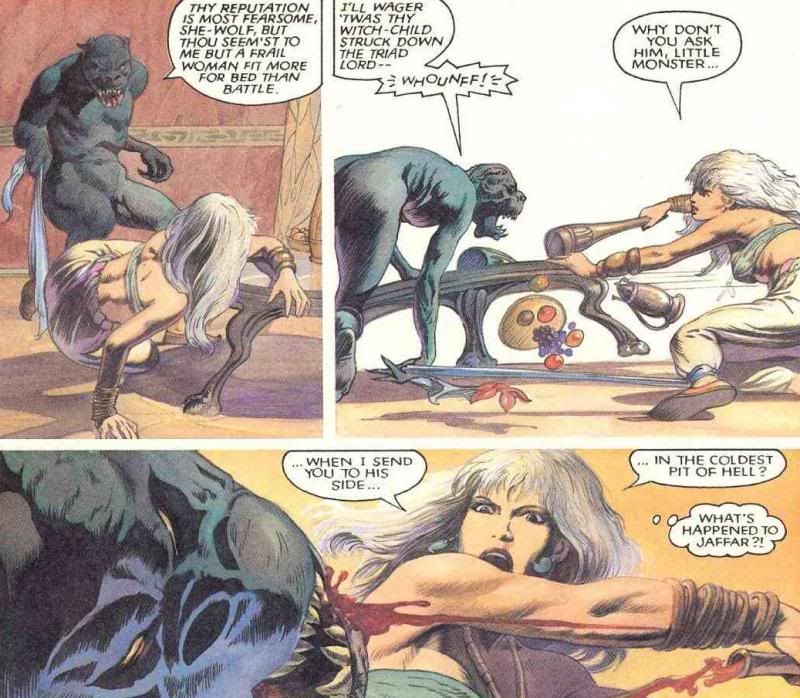
Not enough romance novels include demon killing
The pages look much cleaner in the actual book. These are just some scans I found online.
Unfortunately, Marada the She-Wolf was written and designed by men in the comic book industry in the early 1980s. Considering the problems some male writers have with female characters in this day and age, it’s no surprise that Marada is not exactly a strong, independent woman.
The collected edition is available on Amazon.com.
Join me after the jump for more review.
Review: Thrud the Barbarian
Someday I am going to publish my own comic, and when I do, I hope I have even half as much fun as Carl Critchlow has writing and drawing Thrud the Barbarian. The good people at Titan Comics released a new hardcover collection of the Thrud comics this month, and they sent me a copy for your reviewing pleasure. I had not heard of Thrud before now, but the big lug seems to be popular among the role-playing crowd because his comic strips made regular appearances in the 1980s role-playing magazine White Dwarf. Some of those early strips are included in this hardcover edition, and they’re a hoot. But this book’s main feature is five full-length, stand alone Thrud the Barbarian comics that Critchlow wrote and drew starting in 2002. Fortunately, one doesn’t need a deep understanding of Thrud and his world to enjoy this book.
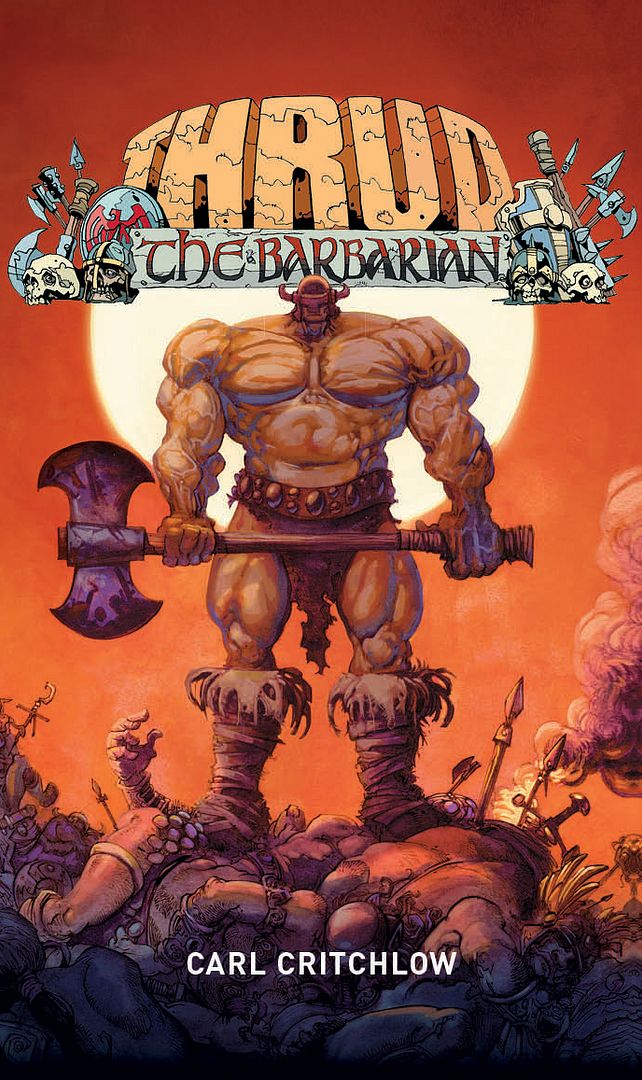
Thrud the Barbarian is more than just a Conan parody. Thrud is a big, beefy pile of physical humor and role-playing revelry. The comics in this collection make for some nice, light entertainment, though I would have personally liked a little more depth behind them. At least Critchlow’s art style is a quest for the eyes, with a flare for medieval carnage and silly comedy.
Comic Rating: 6/10 – Pretty Good.
Thrud the Barbarian is big on muscles and short on brains, but who needs them when all your problems can be solved with a giant ax? Thrud is the biggest, meanest, toughest bad boy in medieval times, but all he really wants in life is some good beer and maybe some gold. And as we all know, pursuit of money and beer is bound to get anyone into trouble. Sure enough, across these five issues, Thrud’s simple needs somehow manage to get him wrapped up into all manner of adventure. Whether he’s hired to escort a scientist on an expedition into a frozen wasteland or he ends up impersonating a king, Thrud’s adventures are always lively. And when drawn in Critchlow’s signature style, I can see why the character became so popular back in the 80s.
The art is detailed and cartoony, exactly how i like it. Critchlow’s style seems perfectly suited to this medieval world, with a penchant for swinging axes, suits of armor and flying heads. This comic features several decapitations, and each one is better than the last – comically speaking, of course. Critchlow can handle the large and the small, from mapping out every muscle in Thrud’s over-sized body to giving full life to the giant monsters he faces.
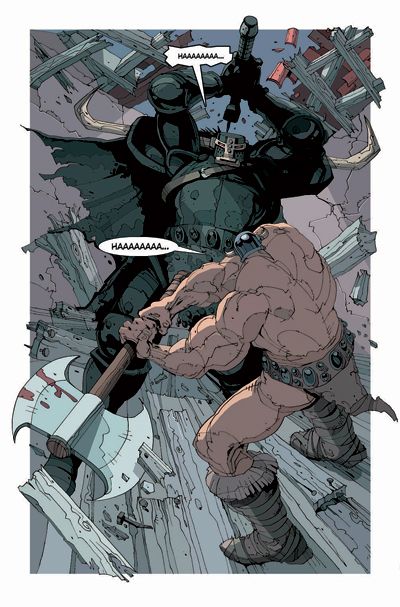
Everybody needs a good arch-nemesis
As much fun as the issues are, part of me thinks Thrud might have worked best in shorter comic strips. The full issues are entertaining, but they don’t offer much depth, especially in Thrud himself. His character really is no deeper than swinging an ax and wanting a beer. So in each issue, it’s the characters around Thrud who actually provide the story. And while those characters do their job, they’re clearly nothing more than filler. Thrud is the only character who matters in each comic, and he’s usually the least interesting. Unless, of course, you get a giddy thrill from the idea of an ax-wielding warrior slicing his way through hordes of enemies. And who among us doesn’t?
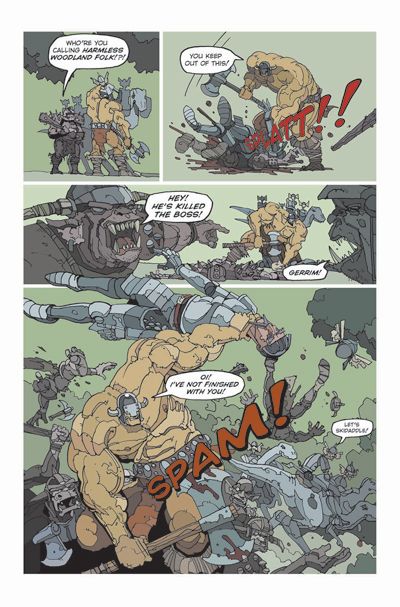
Spam! It’s what’s for dinner!
Thrud the Barbarian is a gleeful comedy series. It’ll give you a few laughs and you’ll have a little fun reading. It’s definitely meant for the role-playing crowd, poking fun at a lot of the popular and familiar tropes. Necromancers, turnips, potions, wrestling and kingly duties all get a good thwopping from Critchlow in Thrud the Barbarian. This is the perfect sort of book to pass around at your next D&D game.
The hardcover Thrud the Barbarian is available at Amazon.com.
Review: Dead Space: Salvage and Dead Space: Liberation
At long last, I have cleared enough space in my busy and penniless schedule to catch up on the Dead Space comics. I have two volumes, Dead Space: Salvage and Dead Space: Liberation, from the good people at Titan Books, so I decided to group them together into one review. They are both companion comics to the Dead Space video game series, taking place around the games. Salvage is a separate tale about a crew of illegal salvagers who come upon the dreaded Ishimura, while Liberation is a prologue comic to this year’s Dead Space 3. Both have their good parts and and their bad, and both are definitely entertaining.
Any big Dead Space fans would probably find a lot to like in these two comics. Fans of intense horror, especially in a futuristic, outer space environment, would also enjoy both books.
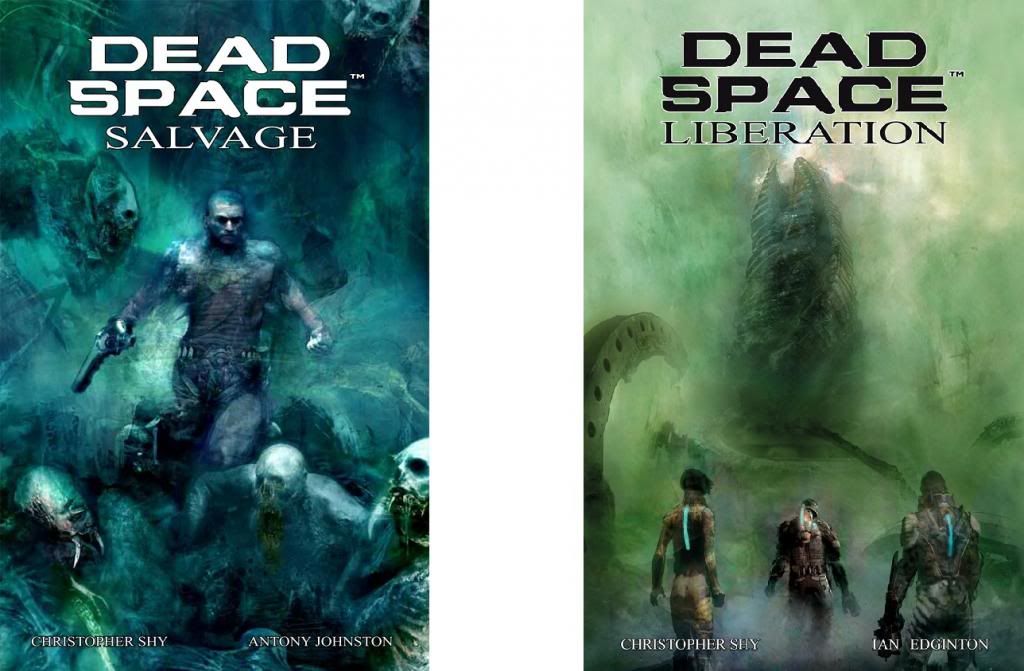
Dead Space: Salvage: 4/5: Good.
Dead Space: Liberation: 3/5: Alright.
Salvage and Liberation are two comics that any fans of the Dead Space universe would probably love to have on their shelves. I wish some of my favorite video game franchises produced comics of this quality. Much like the Dead Space graphic novel I reviewed earlier this year, these are great companion pieces for the games, expanding the universe the games inhabit while providing new adventures with new and sometimes familiar characters.
You can find both Dead Space: Salvage and Dead Space: Liberation at Amazon.com.
Join me after the jump for further review!
Review: Assassin’s Creed Graphic Novels
Assassin’s Creed isn’t just for video games anymore. Like any good franchise, they’ve branched out into other mediums, including a series of graphic novels released in October from publisher Titan Books. They recently sent me some nice hardcover copies of their Assassin’s Creed graphic novels, translated from their original French into English. The art style is definitely very European (not that I’m an expert), and the story is the familiar Assassiny goodness that we know and love. I only wish the series had taken a few more liberties with their story and really explored the larger Assassin’s Creed universe.
The Assassin’s Creed franchise has a lot of room to expand beyond Desmond Miles and the ancestors you play in the video games. And while these graphic novels do a good job with some of their ideas beyond the usual, they don’t go far enough. If you’re an Assassin’s Creed completionist – or perhaps shopping for one for Christmas – you should enjoy this series. But otherwise, the comics are pretty light on material.
Comic rating: 4/5: Good.
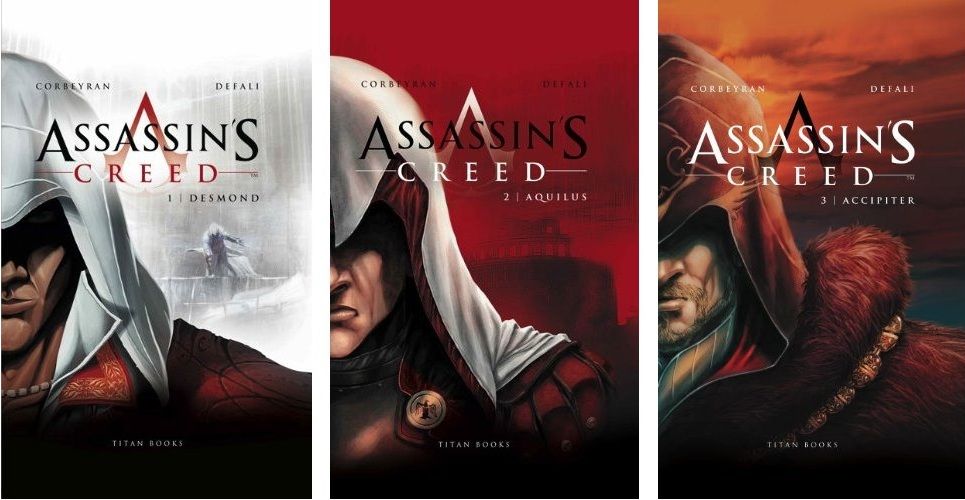
Desmond, Aquilus and Accipiter
The three Assassin’s Creed graphic novels – titled Desmond, Aquilus and Accipiter – tell one long, connected story by following two parallel plots. One is Desmond’s story from the video games, about being kidnapped by Abstergo and then going on the run with Lucy and the Assassins. The other is an original trip into the Animus to visit Aquilus, an ancient Assassin from the Roman Empire. As with the video games, the most interesting material comes from the trips back in time, but writer Eric Corbeyran definitely give us plenty of Desmond action. The guy is much more active and brutal in this series than he is in the games, which is cool to read.
Of the three books, the first one is the weakest because it basically just retreads ground covered in the first game, only in a much more rushed manner. It squeezes in the story of Altair even though it’s completely unnecessary to the overall plot. The two other books delve into original material, including the life of Aquilus and a few adventures that Desmond and his friends have while on the run. The third book is the best of the three, introducing the concept of dueling Animus trips as we see someone else go into the Animus and visit his ancestors. I wish the entire series had been about this new character and his story, but perhaps Corbeyran needed to focus on Desmond and the established game material.
All three comics play hard and fast with the strange concepts of Assassin’s Creed, from the Animus itself to the various characters involved. There were a few times where new characters suddenly pop up and act like we’re supposed to have known them all along, so it was a little confusing. You definitely need an understanding of the games to keep up with the comic. Though considering how big a fan I am of Assassin’s Creed, it wasn’t a problem at all.
You can purchase all three graphic novels on Amazon.com: Desmond, Aquilus and Accipiter. You can also join me after the jump for more review!

 Henchman-4-Hire