Category Archives: Reviews
Review: Justice League #1
The future of comic books is here! Or at least that’s what DC Comics would like you to believe. So far, I’m not convinced.
Today marked the release of Justice League #1, their launching point for a whole line-wide revamp of their most popular characters. This comic has been hyped up the wazoo all Summer long. It’s reportedly had more than 200,000 orders. Justice League was the only comic book that DC put out this week (sort of) in order to ensure that every comic fan worth their collection would get in on the ground floor of their exciting and bombastic new stories!
The comic fails. Not terribly so. But this is a real stumble out of the starting gate.
Justice League #1 feels like one of those extended house ads they staple into the middle of normal comics. Where Superman and/or Green Lantern help some kids wearing Subway brand T-shirts defeat some bad guys with the power of Subway sandwiches. It looks like Green Lantern. It acts like Green Lantern. But it doesn’t feel like Green Lantern.
Instead it feels like a rushed, overly thought-out promotional piece. What’s supposed to be the iconic first meeting of Batman and Green Lantern speeds through its dialogue and its team-up, with the two of them trading not-so-snappy banter as they try and fight some random, monstrous-looking villain. But the writer, Geoff Johns, seems to think that the banter is very snappy. That’s why it feels overly thought-out.
Justice League #1 doesn’t feel new or special. It’s just another comic about Batman and Green Lantern.
At least this first issue of Justice League has some cool action, some strong characterization and some fantastic art. When I say this comic fails, I mostly mean that it fails as the kick-off to the new DC Comics Universe. I was looking forward to reading a clean, complication-free introduction to the Justice League kicking ass and taking names. What I got instead was a comic where Batman and Green Lantern hang out and trade forced dialogue about the ‘newness’ of this world. Barely anyone else appears in the comic, despite the cover featuring seven heroes. No sign of Wonder Woman, Aquaman or Flash. And Batman and Green Lantern are an odd – yet obvious – choice to introduce us to the new DC Universe.
This was not what I was expecting and I am disappointed. Though I’ll keep buying, because it looks like they’re going to try and build up to greatness instead of wowing us from the start – which is what they should have done.
Justice League #1 takes place towards the dawn of the superhero age, which occurred ‘5 Years Ago’ in comic book time. None of the heroes have met one another. They don’t know each other’s secret identities. So this first storyline in Justice League is going to let us tag along as they meet each other and start to work together against a greater threat. There are several scenes in this issue where the ‘newness’ of it all is thrown at us. For example, Green Lantern is shocked when he finds out that Batman is just a man in a costume and doesn’t have any bat-powers. The cops are also openly trying to shoot the heroes, placing them firmly on the opposite side of the law for now.
But for all this freshness, no one seems bothered at all that the villain suddenly transforms into a giant, mechanical, alien-looking spider monster. It’s just business as usual.
And that, I think, is my main complaint about this comic, one that is felt in both the writing and the art: this doesn’t feel new.
The costumes, powers and personalities remain the same for Batman and Green Lantern. So what if the cops are shooting at them? That’s not a big enough change. Why couldn’t this comic work as the first meeting between these heroes in the old DC Univers? There’s nothing that makes it feel like it’s this new world with new histories and background. Heck, for Batman and Green Lantern, they don’t even have new histories or background. More on that later. The heroes look and act the same as they always have. They’re fighting a similar villain to what they’ve always fought.
The art reinforces this idea.
Jim Lee is, without a doubt, one of the most popular artists in comic books. His characters are dynamic and detailed, his action scenes are exciting and he draws some pretty awesome Green Lantern ring-constructs. His Batman is one of the reasons I started reading DC comics back in college. I was reading a few Robin issues, and Batman was right in the middle of a big storyline entitled Hush, about a new villain. Jim Lee was drawing every issue for a whole year. The art was beautiful.
But that’s the problem, I’m very familiar with Jim Lee’s artwork! As are most comic book fans. So when we draws these supposedly ‘new’ versions of Batman and Green Lantern, they look just like the old versions. Of course it makes perfect sense to put your most popular artist on this very important issue, but all it does is remind us of the old stories. This issue should be making us look to the future, not have us reminiscing about the past. Minor spoiler, the cliffhanger character appears on the cover. Surprise!
So Justice League #1 fails as an introductory issue to both the team and the new DC Universe. We get a nice, if incomplete, introduction to Green Lantern and Batman, but they could very well just be the same characters from the old DC Universe. Nothing in this issue screams new or exciting.
Hopefully issue #2 can make up for some of these shortcomings. The problem is that it won’t come out until October. Between now and then, there are 51 other brand new series coming out. All those new #1 issues, surely some of them are going to be more exciting and memorable than this issue.
Which shouldn’t be the case. Nothing should be bigger or more bombastic than the Justice League. Oh well.
That’s my review of the issue, but maybe you’re interested in a little background for any readers who have no idea what I’m talking about. What’s this revamp, you ask? I’m going to assume that you have a passing knowledge of the iconic superheroes: Superman, Batman, Green Lantern, etc. They are all from DC Comics, one of the two main comic book companies. Their competitor, Marvel Comics, has Spider-Man, Captain America, and the X-Men in their stable of heroes. Both companies have been publishing comics about these heroes since at least the 60s, sometimes even longer. Batman and Superman have been around since the 30s!
But all those years of stories and all of that continuity add up! Comic fans want their heroes to learn lessons that carry over into the next issues, to grow and change. But new readers might be afraid to pick up a new comic because they think they have to know 30+ years of comic book history to understand what’s going on. Someone new to comics might not want to pick up Superman #662 because they haven’t read the 661 issues that came before.
Both publishers are aware of this problem and take steps to make comics more accessible. Well this Fall, DC Comics is taking an extreme step to make their comics more new reader friendly. They are doing a line-wide reboot of their titles, starting over with new #1 issues and stripping away all that cluttered up continuity. The characters are staying the same, for the most part. Superman will still be Superman. He just won’t have the same baggage that he’s had for the past few decades.
But DC isn’t going for a full clean slate. They’re not starting over from the ground floor. Some characters will have a few minor tweaks, some characters will be rebooted entirely, and some characters won’t change at all. Which brings us back to Batman and Green Lantern and why they are an odd -yet obvious – choice to be the stars of Justice League #1.
In part, this reboot is due to low sales. DC has always trailed behind Marvel. DC’s two most popular comics are from the Batman and Green Lantern franchises. So it makes sense that the first issue of this reboot would star their most popular and profitable characters. However, Batman and Green Lantern have not been revamped at all. The stories and characters from before the revamp will be carrying over into the revamp. Nothing is changing. At least nothing major. So I find it odd that they will introduce us to the new DC Universe considering they will remain exactly as they were in the old DC Universe.
At least this new issue gives writer Geoff Johns a chance to flesh out their characterization.
Though their dialogue sucks and feels very forced, Green Lantern is charmingly cocky and Batman is quietly stoic. We can really get at the heart of their personalities, which should be fun as the series continues. Hal is supremely confident in his Green Lantern powers. Whereas Batman doesn’t give a shit about the fancy glowing hero, Batman just wants to get the job done. They’re both tracking a vaguely monstrous villain in Gotham City, one who works for the big bad guy, but we don’t see that super-villain yet.
To set the stage, DC’s revamp involves cramming all of their important continuity down to a 5 year span. In this new DC Universe, superheroes have only been around for five years. They’re fresh and exciting, but people aren’t sure they can trust them just yet.
It’s an interesting take on superheroes and the public. Not new, but it could be a good read with such iconic heroes. Supposedly the new Superman is going to be more alien in nature, and he won’t be the beloved hero. We’ll see how that goes.
In the end, I’m excited for the reboot but disappointed in the first issue. But DC has plenty of chances to win me back!
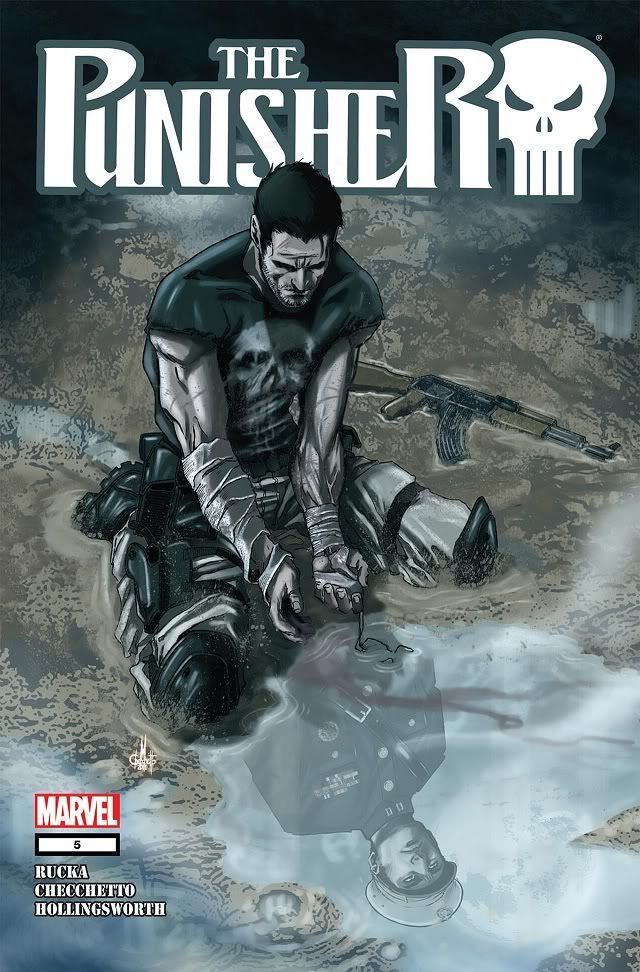
Review: Punisher #2
With the second issue of the new series, writer Greg Rucka continues his tale of the wraith-like, silent Punisher and the investigation into the wedding massacre. Once again our focus is on NYPD detectives Celmons and Bolt, split with the continuing adventures of the killer, who is being stalked by the Punisher. We get a peek at the people behind the massacre (I think), but we’re no closer to discovering why everybody at the wedding had to die. Still, the series is rich, dark and fun to read.
Until they blow the cliffhanger with a frankly silly new addition to the story!
But more on that later. For now, let’s start with the Punisher. Once again, Rucka gives us a Frank Castle who doesn’t say a word and doesn’t have an inch of internal monologue. Though no longer as spectral, thanks to the art, he still doesn’t say anything. The Punisher goes about his killing in utter silence, and there’s a lot of killing this issue. But I’m already getting tired of the silent act. The supporting characters are good so far, at least the detectives are. But I want to read about Frank Castle, not a bunch of nobodies.
Hopefully the villain they inject into the cliffhanger will at least get the Punisher to speak next issue. If only it wasn’t such a lame villain.
We start off following the killer from the first issue, the goateed guy who gunned down people at the wedding but survived the Punisher’s club massacre at the end of issue #1. This guy is running like hell through the streets of New York, trying to go to ground. But nobody’s willing to put him up. So he just keeps running through the dark, grimy streets of New York City. We’re treated to narration by two people named Stephanie and Christian, who we see a bit later standing on a rooftop with a group of other people. They’re dressed like rich people and are talking about the killer, and how the only reason the Punisher let him live is to track him, which would lead the Punisher to Christian and Stephanie.
And sure enough, that’s exactly what Frank Castle is doing. Though still in the shadows, Punisher is now drawn in such a way that we can clearly see his face. He’s no longer a stealthy ninja, as in the first half of the first issue. You may remember that issue #1 was split into two parts. In the first part, Punisher only appeared in shadow. In the second part, he was in the light. In this issue, all one story, he’s in the light again.
Because of my love of the Garth Ennis Punisher series, in which Frank Castle was a hard man pushing 50 with a lot of years on him, I’m not a fan of this young, handsome Punisher. But it’s not a big deal.
Stephanie and Christian aren’t worried because they’ve hired someone to take care of the Punisher. We see this person only in shadows for now, and he has claws and glowing red eyes. Someone badass perhaps? Just you wait and see!
We jump to the daytime, with detectives Clemons and Bolt investigating the club massacre that ended the first issue. Oscar “Ozzy” Clemons is the Morgan Freeman guy, and he’s convinced that the Punisher is responsible. The kills are far too clean, far too precise. That’s Special Forces training right there. So now they’ve got the Punisher to deal with, messing up their case. They’ve got a job to do, doesn’t the Punisher understand that?
Speaking of jobs to do, in comes Norah Winters, a reporter for the Daily Bugle and a supporting character from Amazing Spider-Man. Now this was a fun cameo. One aspect of this Punisher series is that it’s firmly set in the Marvel Universe, complete with superheroes and mutants and whatnot. So it’s smart that, instead of making up some random reporter, Rucka just borrows an existing reporter character from Amazing Spider-Man. Norah’s fun and sassy in this issue, and has clearly worked with Clemons before. Unfortunately, their entire conversation is about Norah and we don’t really learn anything new about Clemons or Bolt. It’s an extended explanation into who she is and what she does. Hopefully that means she’ll be making routine appearance in this comic.
Being a newspaper reporter myself, having one as a character is always a hoot.
Let’s stop here for a moment and look at that picture I just posted. This is a pet peeve that’s only going to bother someone like me, who is a crime reporter for a newspaper in real life. Just like most jobs, Hollywood and other media tend to exaggerate a reporter’s job. I realize that Norah is supposed to be a sassy and edgy reporter, but she’s all over the place in this issue. I realize she may just be joking with her friend Clemons, but when a homicide detective tells you that you can’t quote him on the details of a murder investigation, you don’t quote him on the details of a murder investigation. You have to maintain sources as a reporter, and to do that you have to maintain their respect. If they tell you something ‘off the record’ and tell you not to quote them, you don’t do it. That tends to piss them off. Bad enough she snuck past the police tape into an active crime scene.
Honestly though, I’m probably just being silly. It’s comics, not real life. And my dinky little city isn’t New York City, so maybe it’s different there. Still, it’s one of those things that will only make someone in my specific circumstance stop and shake his head.
This scene is awesome, though, because it name drops Phil Urich. Longtime readers of my blog will know that Phil Urich was one of My 6 Favorite Comic Book Characters. His current comics status quo is that he’s a cameraman for the Daily Bugle, who is making some cash and fame by filming himself as the villainous Hobgoblin and selling it to the Daily Bugle. Exactly like Peter Parker did when he took pictures of Spider-Man. So it’s awesome that Phil gets a mention in a Punisher comic. It means Marvel is really pushing him as a character that will stick around. What’s silly, though, is that Phil is being treated like a TV cameraman. They say that Phil is filming Norah doing her reports. I know the Daily Bugle is mostly an online newspaper now in comics, but do they really do more video than newspaper reporting? Norah can easily make the leap from anchorperson to writing reporter? Those are two rather different fields, especially when it’s clear that Norah prefers the writing.
Kind of an odd sort of crossing of wires in terms of what the Daily Bugle is doing these days. Still, woot Phil Urich!
But I digress. Back to the Punisher!
After the extended introduction to Norah, we jump back to the Punisher chasing the goateed killer. His name is Liam, by the way, and he’s found a brothel to hide in. The owner kicks him out on the street, tossing him into the gutter. Oops! Punisher’s right there, right outside! Liam scrambles to his feet and keeps running, while the Punisher decides to pay the brothel a visit. In silent fashion, Punisher lets himself in and starts blowing away the druggies and the gang-bangers – but he doesn’t harm the girls. Punisher doesn’t kill prostitutes, especially ones that are hooked on drugs like these girls. But he does kill the owner, even when the guy tried to take a hostage, and he kills the ‘madame’, who was using drugs to keep the girls in line.
The art in this scene is clear and easy to follow, if a little scattershot. The panels are not square and gridlike, with a few experimental angles. What works great are the colors. The scenes on the street with Liam are blue and black, while inside the brothel we switch to a fuchsia. The rooms are bathed in fuchsia, and soon blood. The Punisher’s kills are sharp and bloody. One is especially cool when they just show the silhouette of the owner (in fuchsia, not black) and he’s got the detailed, bloody bullet hole in his head. Punisher leaves and the drugged out girls in the brothel are free. I guess.
We jump back to Clemons and Bolt, who have gone to visit the bride in the hospital. She’s practically the only survivor of the wedding massacre, and she’s finally woken up. It’s a quiet, soft scene in which she tries to remember what happened. Then she remembers everything…
In the end, Liam has made it back to his bosses, though not Christian and Stephanie from earlier, just some other people who were working with Christian and Stephanie. One of them is a pretty redhead named Dove. She kills Liam with a shotgun, and the Punisher watches from afar through the scope of his sniper rifle. Once Liam is dead, Dove turns to look up Punisher’s scope to tell him that she knows he’s there and she’s ready for him.
Enter cliffhanger villain…the new Vulture!
What is this crap!? This character is a guy named Jimmy Natale, who used to be a mafia ‘cleaner’. But then the mob turned him into a murderous bird monster-man who now wants to get his revenge on mobsters, or something. Sometimes he works for the bad guys. He fought Spider-Man a few times as some kind of vicious freak. He has no connection to the classic Vulture though, nor to the Punisher. He’s just some monstrous new take on the classic villain created during the period when Marvel wanted to give Spider-Man some new villains to fight. But the point I’m trying to make is that this is the lamest, one-note, bottom-dwelling super-villain that they could possibly throw at the Punisher. They build up this hidden, surprise super-villain…and it’s the new Vulture?
What a chump!
I can only hope they needed to find some bargain bin super-villain for the Punisher to kill. For you see, that’s the problem with bringing the Punisher into the normal Marvel Universe. If you want to have him go up against costumed super-villains, he’s going to want to kill those super-villains. That’s why Garth Ennis’ Punisher took place in its own separate world. And why when they brought Punisher back to the Marvel Universe during Civil War, he almost immediately killed Stilt-Man.
So I guess Marvel’s just throwing out some lame super-villain who, in theory, will be able to put up a fight. The character of the new Vulture is that he’s vicious and monstrous. So it could very well be a brutal battle in issue #3. I’m sure he’ll definitely give the human Frank Castle some problems. He’s just a laaaaaame villain.
All-in-all, it’s a good second issue. The story continues along on both fronts, though not very far, I’m afraid. We meet the bride who survived, and we meet the people who were behind Liam and the killers. So the story is moving. Unfortunately, we don’t get to really know anything more about the protagonists. Punisher remains silent, ‘speaking’ only with his guns. He kills and moves on, as the Punisher does. He continues to be badass, but this silent treatment isn’t going to be as much fun if it continues much longer. Detectives Clemons and Bolt are back, but their character development is brushed aside so that we can be introduced to Norah Winters.
While it’ll be fun to have Norah in the book, if she sticks around, we didn’t really get to know anything more about the two detectives, who we know will be the main protagonists. Bolt, especially, was in the background this issue, while he was the main character in the last issue. So while the story may have progressed, the characters did not.
At least the art was once again phenomenal. The right mix of action and gritty, street-level talking heads. I love realistic art in my comics, as opposed to silly superhero fantasy, so I’m enjoying the art. This is definitely a book to keep reading. I’m going to try to keep going with every issue, since I’ve had the luxury of starting with issue #1.
What do you all think? Should I keep reviewing the Punisher?
Game of Thrones is Awesome. There, I said It.
I just finished watched Season 1 of HBO’s Game of Thrones, and I have to say that it more than lived up to the excellent and exciting hype! The show was marvelous, the characters were well-rounded and fun to watch and the cliffhangers for Season 2 were downright brilliant. Amazing, amazing show. I’d thought about doing a full, in-depth review, but I wouldn’t want to spoil anything for anyone else. I’m glad now that I have not read the books because I wouldn’t want any of this spoiled.
Especially that final scene!

Boromir no more!
Like I said, I won’t get into spoilers. But I can talk in general about the show and hopefully you’ll be willing to give it a chance. HBO has created some fantastic shows. Though I’ll admit I’ve never seen a single episode of The Sopranos. Maybe now’s a good time to start. But I saw Carnivale and loved it. Anyway, Game of Thrones is a medieval tale about politics and personality, with a bit of fantasy thrown in for fun. It’s based on the book series A Song of Ice and Fire by George R.R. Martin, and is really popular, from what I get off the Interwebs. Though I’d never heard of it until the show started.
Let’s start with an overview. If you take my advice and watch this series, you can use this to better understand what you’re looking at. I know I was a little lost, at least in the beginning.
We find ourselves on the continent of Westeros, with our hero, Ned Stark, played excellently by Sean Bean, of the Lord of the Rings. Ned and his family, Clan Stark, rule over the town of Winterfell far in the north. Ned is a decent and honest man, beholden to the law and trying to do right by his people and his children. His wife Cat is noble and loyal, herself from a lording family. Their children are just as good as their father, not a schemer or villain among them. Rob is the eldest, learning well his father’s lessons. Jon Snow is Ned’s bastard son, and Cat can barely stand to be in the same room with him. But Jon is a good man, and one of the stars of the show. Daughter Sansa is princess-like and regal, while youngest daughter Arya is a spitfire who doesn’t like the idea that she’s destined to just be married off and pop out children. Young son Bran is known for being a good climber, and then there are a few younger children who don’t do much.

Arya Stark has enough awesome for all the children. Remember that.
Ned would like nothing more than to take care of his people and prepare for the coming winter. For you see, in Westeros, the seasons aren’t like here in the real world. They’re split between Summers and Winters, both of which can last years on end. And years of harsh, cold, dark Winter can be brutal. Hence Clan Stark’s catch phrase, “Winter is coming.”
Life will always get harder.
Especially when politics come into play.
In the first episode, Ned gets a visit from his old friend King Robert Baratheon. Nearly 20 years ago, Ned, Robert and their allies dethroned The Mad King and took over rule of Westeros. Robert became ruler of all seven kingdoms, but mostly the land split into different towns and castles, each lorded over by the various family Clans. When they deposed The Mad King, Ned, Robert and their allies split power through various arranged marriages.
Robert’s wife is Queen Cersei of Clan Lannister, played by Lena Headley, the queen in 300. She’s a cold, scheming woman whose marriage to King Robert was never anything more than a political move. Clan Lannister is the richest and therefore one of the most powerful clans in all the kingdom. They are known for their blonde hair and their catch phrase, “A Lannister always pays his debts.” The main conflict of the show is between the Lannisters and Starks, with King Robert caught in the middle. The Starks are good, honest people, while the Lannisters are cruel and conniving. Guess which one has more luck in the realm of politics, otherwise known as the Game of Thrones?
Queen Cersei has two brothers: the handsome knight Jaime and the wickedly smart dwarf Tyrion, played with extreme brilliance by Peter Dinklage. He is the standout character of the show. Tyrion is smarter than everyone else, and he knows it. Because he’s a dwarf, he’s always been looked down upon, especially by his father, the head of Clan Lannister. So he’s had to work extra hard to get everything in life, made much easier by his wit and his charm. You can never tell who’s side Tyrion is on, but in a good way. He may be a schemer and a Lannister, but you can sort of tell that Tyrion is a good person. So watching his journey through the show is one of the best parts!

Awesomeness squared
At any rate, King Robert has come to visit his old friend Ned Stark because he needs Ned to serve as his right-hand man in the capital, King’s Landing. The old right-hand man died under mysterious circumstances, or so Ned begins to discover once he moves into his new home. The show follows the adventures of Ned and his two daughters as they try to fit in at King’s Landing, while the rest of his family continues to preside over Winterfell. If you love political drama, this is the show for you. There are many schemers and more treachery than you can shake a fist at. There are a lot of surprising twists that I didn’t see coming, and all of the characters seem fully-rounded with depth and opinions. Nobody’s intentions are truly clear, which makes for an exciting show to follow.
Along with the political drama, there are two side-stories that add fantasy and barbarian elements to the show. The first is The Wall, located at the northern most tip of Westeros. The Wall is simply that, a giant, manmade wall that separates the continent from the mysterious and fearsome north, a wintery land where giants and monsters are rumored to dwell. A thousand years ago, the people of Westeros repelled an invasion by the White Walkers, and ever since, the noble brotherhood of the Nightwatch has guarded The Wall. But a thousand years have passed, and the Nightwatch isn’t the proud group it once was. They’re made up of criminals, runaways and only a few true knights.
So what are they going to do when the White Walkers return?
And what’s the kingdom going to do? The White Walkers don’t give a shit about all the petty bickering and politics. There are some really awesome scenes towards the end of the season, when the threat beyond The Wall starts getting more real. Because what does the game of thrones really matter when literal monsters are going to start invading the land?
The barbarian saga comes from across the sea, where the last two children of The Mad King were exiled. Fair-haired Daenerys Targaryen and her conniving brother Viserys long to take back their rightful throne from King Robert, but they’re just two people. So Viserys, a truly evil man, force-marries his sister to Khal Drogo, the barbarian ruler of the horselords. Viserys intends to use the horselord army to go back across the sea and fight King Robert’s armies. But the meek Daenerys quickly takes to barbarian life, and by the end of the season, she’s got a few surprises up her sleeve.

Not the least of which is boobs. There's a lot of nudity in this show
So that’s the show in a nutshell. Again, I highly recommend you watch. They’re already working on Season 2, so you know it’s going to be around for awhile. The politics are great to behold, with some truly surprising twists and turns. The characters are really fun, especially Tyrion the dwarf and Arya the youngest daughter. Even subplots that don’t seem to be very interesting in the beginning, like The Wall and the horselords, turn out to be truly awesome in the end.
There are a lot of characters and a lot of names that one has to try and remember, and it can be difficult at first. But if you pay attention, you’ll get the hang of it. Like any fantasy world, such as Lord of the Rings, it’s not difficult at all to immerse yourself in the goings on of the world. Strange and volatile Westeros may be, but it’s an awesome place to visit.
Hot Girl/Girl Action
That’s right everybody, my blog is now going to bring you some hot girl/girl action straight from the comic book page! We’re talking the sexiest superheroines this side of Supergirl, ready to get into hot and heavy action in the name of saving the day. And by ‘action’, of course, I mean fight bad guys and literally save the day. And by ‘hot and heavy’ I mean it’s probably exhausting being a superheroine, and I’m sure they worked up a sweat.
Why? What did you think I was talking about?
The girls in question are Zatanna and Power Girl, two semi-popular superheroines whose final issues dropped last week. They’ve been cancelled. As I’ve mentioned a few times before on this blog, DC Comics is doing a line-wide revamp next month. That means all of the current comics are getting cancelled, including the solo adventures of Zatanna and Power Girl, two of my favorite DC comics. It’s a shame to see them go, so I figured I’d show them off in style by reviewing their final issues: Zatanna #16 and Power Girl #27.
First, a word about these types of comics. I love these types of comics. Zatanna and Power Girl are clearly not A-List heroes, like Batman and Superman. Yet with the right writer and some good ideas, DC Comics took a chance and published these series anyway. Comics are filled with hundreds of obscure and seemingly unpopular characters, and every once and awhile, DC and Marvel will put out a series or mini-series starring these characters. Sometimes they’re bad and sometimes they’re great. But I love that comics will take the chance anyway.
It enforces my writing motto: “There’s no such thing as a bad character, only bad writers.”
And fortunately with the Zatanna and Power Girl series, we got good characters, good writers and great artists! Both of their final issues are standalone stories with fill-in writers, so I won’t need to catch you up on any ongoing storylines. They’re both pretty good stories, and are also pretty good examples of what each series was like. Though the Zatanna comic is leagues better than Power Girl.
So let’s start with Zatanna.
If you can’t tell from her ‘costume’, Zatanna is a magician. Literally. Her day job is as a classic stage magician who tours and puts on shows all around the world. The catch is that she’s using real magic, and that’s why she’s a superhero. All she has to do to cast a spell is say it backwards, and she can do almost anything. Want to pull a rabbit out of her hat? All Zatanna has to say is, “Raeppa tibbar!” It’s a pretty neat sort of ability. Not many magicians in superhero comics.
Zatanna’s series was about her juggling her stage show and real life with her duties as a superheroine, often with her having to stop some magic-based super-villain. There were a few standalone issues, and some multi-parters. There was a hunky cop who sometimes flirted with her, and she had a stage hand/assistant who helped out from time to time. The main villain, Brother Midnight, was sufficiently spooky and had a storyline or two. Zatanna defeated him in the end. Several issues also featured her cousin Zachary, who was basically just a young, male copy of Zatanna. I never liked him, so ignore him.
The comic was written by Paul Dini, one of the creators of Batman: The Animated Series. Dini is a huge Zatanna fan, and I like to imagine that the series was DC’s gift to him. Like a pet project. Dini and his fill-ins wrote some awesome stories. There was the time she fought the villain who could rewind time, so in order to cast spells she had to speak in only palindromes. Or the time she was almost married to a studly Vegas casino owner so that he could sell her soul to a gambling demon. And my favorite story was probably the time she had to fight a cursed ventriloquist who had been turned into a psycho puppet.
Basically Zatanna got up to all manner of magical mischief, and the final issue is no different. We start on a cross-Atlantic plane ride, with Zatanna taking a red-eye home after a few shows in Europe. Writer Adam Beechen is telling the story with a third-person narrative (different for the series), and it has a fun, playful style to it. The plane almost crashes, but Zatanna raises her sleeping eye-mask, casts a ‘repair’ spell and fixes the plane. All is well and she can keep trying to sleep, though she can’t seem to drift off. When she lands, she’s stuck in customs for a bit and finally makes it home. She crashes into her bed, still super tired, but it seems Zatanna doesn’t get to sleep this night.
Let me take a moment to say that the art in this issue, by Victor Ibanez, is amazing! It’s a realistic take on the traditional superhero style, and I love it. Zee looks and moves like a real person, not just a flighty superhero. Her facial expressions are a delight as she’s forced out of bed to deal with the books antagonist: the witch boy Uriah. He’s basically just a troublesome little scamp who knows how to use magic. He’s woken Zatanna up in the middle of the night because he wants to be her apprentice. Zatanna is very tired, so she politely tells him to get lost. Uriah doesn’t listen and decides to run wild in her house.
Precocious as he is, Uriah finds Zatanna’s massive library. It’s filled to the brim with magical tomes and books, and Uriah grabs The Book of Maps. The book is what he came for, and it’s supposed to know all the passages and short cuts between dimensions. Uriah’s plan is to use the book to become the most powerful being ever, then perhaps he’ll take over the world. Zatanna can’t allow that, so she chases Uriah from dimension to dimension.
In order to catch Uriah, Zatanna casts a teleportation spell that takes them both to The Dimension of Gargantuans! This next page was wonderfully breathtaking. There are ads in comics, and pages that need to be turned. So a lot of great writers will use those to create a slight cliffhanger and a nice shock page. You see Zatanna chasing Uriah through the portals on one page, read her casting the teleportation spell at the bottom of the page, and then you turn the page to find this:
That’s just awesome and gloriously magical. This is the sort of fun that the Zatanna book brought to the table time and again. When magic combines with awesome, creative writing, you get some really fun adventures. That’s why I enjoyed Zatanna so much. The book never had a consistent artist, but it always had great art issue after issue. And even when Dini wasn’t writing, the fill-ins did a great job.
So Zatanna catches Uriah and takes him back to his witch town. She puts The Book of Maps back into her library and finally gets a moment to sleep. There’s a running gag about her trying to enjoy a dream with studly men and cocoa butter, and the final page shows Zatanna in a sexy bikini standing on a beach, with studly men waving from the ocean. Looks like it’s going to be a fun dream and she’ll be able to get some rest.
This was a fantastic issue and a great send-off to the Zatanna series. It’s fun, zany and funny, with great facial expressions and comedic panel-work. Uriah is hardly a classic villain, but he serves his purpose of being bratty and annoying – two things Zatanna does not want to deal with while she’s so tired. And that added level of being exhausted greatly humanizes Zatanna. She’s tuckered out and just wants to sleep, but instead she has to deal with this annoying thing. We’ve all been there. Humanizing superheroes is the way to make them really stand out as interesting subjects. This issue does a great job of that. I’m sorry to see Zatanna go.
Up next is Power Girl #27, a less interesting comic but still a nice, solid farewell.
Power Girl has a complicated background, but I’ll try to explain it in simple terms. Everybody knows Superman, right? And everybody knows or can understand the concept of Supergirl? Well Power Girl is an alternate reality version of Supergirl, who is now living in the normal DC reality. But none of that matters to this series. All you really need to know is that she’s a youngish woman with all the powers of Superman, who’s trying to make it on her own in New York City. She’s the head of her own tech company, but faces all manner of business and financial problems throughout the series. The book is high on humor and charm, with more than a few bad guy fights to enjoy. It’s not as whimsical as the Zatanna series, but it was fun.
Especially in the beginning for the first 12 issues, when it was written by Jimmy Palmiotti and Justin Gray, and was drawn by Amanda Conner. I assume they had the initial pitch for the series, and those first 12 issues are phenomenal. They tell the story of Power Girl as a real person, struggling with her day-to-day life while also trying to be Power Girl. She faces off against some tough bad guys, including 3 diva-like alien women who just want to party on Earth, and an overly macho, Zap Brannigan-esque, hairy-chested space stud who wants to mate with her. The stories were funny and friendly, and the art was amazing. Conner drew those picture I posted above, and she draws absolutely gorgeous facial expressions and body language. Power Girl also has the most adorable cat in all of comics.
The stories were largely inconsequential. If you’re a Power Girl fan, the comic was probably a godsend. Straight forward, fun adventures starring your favorite superheroine. But the action was never great. The Power Girl comic succeeded because of the humanity in the main character. The writers, even those that filled in after Palmiotti and Gray left, wrote plenty of scenes of Power Girl at home. She played with her cat, worried about her social life and struggled to keep her company from falling apart. At times the idea that she ran her own massive tech company seemed to stretch credibility, but it never got too out of hand. Other superheroes have been CEOs before.
The final issue is a story about a super-villain giving Power Girl one minute to save 3 different people on 3 different sides of the world. Theoretically she only has time to save one, and the villain wants to find out and take note of which choice she makes. Will she save the old people at the top of the Leaning Tower of Pisa, will she save the random fishing girl in east Asian or will she save her superheroine friend Cyclone? All three are being attacked by super-villains, so who will Power Girl save in the minute time limit?
All of them, of course.
First Power Girl drops a giant boulder into the ocean, creating a tidal wave that will come into play later. She has the strength and speed of Superman, so she’s able to fly all the way to Brazil to save Cyclone first. She beats up the super-villains who are holding her prisoner and gives Cyclone a message to meet her in east Asia in 25 seconds. Power Girl then flies to Italy and beats up the villain who is trying to knock over the Leaning Tower of Pisa. Power Girl puts the tower back up (though not all the way straight) and flies off to east Asia to save the fishing girl.
Along the way she stops to save a cat in a tree. Kind of a dumb thing to waste precious seconds on, but it’s sort of a call back to the adorable cat from the Amanda Conner issues!
The tidal wave she created at the start comes and hits the super-villain, stopping him from killing the fishing girl. Then Power Girl shows up to knock out the villain. Then Cyclone shows up, and together they use their powers to stop the tidal wave.
In the end, Power Girl is able to triangulate the location of the lead villain who put her up to these 3 tasks in the first place. It’s revealed to be the Calculator, an intelligent, computer-based, thinking super villain. She flies to his base but finds out that Calculator isn’t even there, he’s just talking via monitor to his goons. Calculator sort of explains that he was making notes of who Power Girl saved and in which order, to better predict superheroes’ actions. It’s not very clear, at least not to me. And the book ends with Power Girl getting ready to interrogate the goons to figure out more of the Calculator’s plans.
And that’s where it ends.
Kind of odd really. One is led to believe that it’s leading into a new storyline. But again, this was the last issue. It’s written by a guy named Matthew Sturges, who I am not familiar with. And it’s drawn by Hendry Prasetya. Neither one is part of the regular creative team for Power Girl, they’re both fill-ins. They both do an acceptable job. No one’s art will be as good as Amanda Conner, so there’s no point in trying. Sturges tells a good story, even if it doesn’t work very well as a send-off. It’s just a neat little adventure. Sturges even mixes in some of the humor of the series, but that too is a sub-par effort compared to previous issues. So for its final issue, Power Girl takes a step down in quality, but it’s not so bad.
In the end, these two issues were nice endings to each series. Zatanna was fantastic, and Power Girl was OK. I’ll be sorry to see the two titles go because they were some of the few that I and friend-of-the-site Alyssa both read. She even introduced me to Power Girl. Hopefully we’ll find some new ones to read together after the revamp.
Comic Review: ‘X-Men: Schism’ #3
In my effort to do more comic book reviews, I’m going to throw down with another of the big Event Comics coming out of Marvel this summer: X-Men: Schism. This will be my first time visiting X-Men Schism, and sadly I’ve found it to be lacking.
It’s a fun X-Men comic, but it’s utterly failing at its two main points: splitting up Cyclops and Wolverine and introducing some new villains.
X-Men: Schism is essentially the prologue to the next big X-franchise reboot this fall. For years now, the X-Men have been hanging out and doing their thing on the West Coast. They abandoned the classic X-Mansion in Westchester and moved out to their own private island off the coast of San Francisco, then named it Utopia. The X-Men claim they’re their own sovereign nation; whatever. The point is, all the mutants are now living on Utopia with Cyclops leading the X-Men. They’ve been nice and comfortable for years, fighting baddies and doing superhero stuff.
So now it’s time to break them up, it seems.
The main thrust of this story is supposed to be that some dangerous something or other has come along that’s going to drive a wedge between Cyclops and Wolverine. They’ve never really gotten along, but for decades now they’ve been respectable pals. They trust each other, fight alongside each other and can count on each other. Well the new X-franchise reboot is going to involve a split where each one takes one half of the team and forms their own X-Men. So how do we get to that position?
By issue #3 of the 5-part Schism, I’m not really sure. Absolutely nothing that’s happened so far has convinced me at all that we’re heading to a monumental split of the X-Men, or even a minor split between Cyclops and Wolverine. Writher Jason Aaron is basically feeding us a few minor squabbles so far that I guess are going to lead to the bigger split between the two. But there’s just so much history and friendship between Cyclops and Wolverine that even they seem to acknowledge that getting at each other’s throats is silly.
The story itself is actually fairly cool, and would make a good X-Men story. With mutants gathering power on Utopia, Cyclops and Wolverine attended a world conference about peace and security in issue #1. Cyclops gave a good speech and argued a bit with some jerkly diplomats. Then an evil mutant punk crashed the party and used his telepathy to start making all the diplomats admit their darkest secrets in front of the TV cameras. It’s a minor terroristic prank from a third-rate character – but it pisses everybody off. All around the world these diplomats are calling on their countries to bring their old Sentinel robots out of storage to once again defend themselves against mutants.
That’s a good idea, and I’m enjoying that part of the story. Under Cyclops’ leadership, the X-Men step up and start taking down these idiots and their mutant-killing machines.
Then the evil mutant punk asks for asylum on Utopia, and Cyclops gives it to him FOR SOME REASON! Cyclops’ decision to protect the jerk-whistle who started this mess makes very little sense. Sure there’s the sense of protecting a fellow mutant, but since when has that been an option? Whenever the X-Men beat up evil mutants in the past, they didn’t take those guys under their wings to protect them. It’s a decision that seems forced just to cause a riff with Wolverine, since Wolvie wants to turn the punk over to the proper authorities.
I’m really getting the sense that Cyclops is supposed to be in the wrong here. Because the next little squabble comes in issue #3. One of the young student characters, Idie, is out in the city with some other X-Men when the bad guys attack (more on them later). Idie is a scared teenage girl, and she’s hiding. When she’s the last X-Man standing, she’s able to get on the radio to the others. Wolverine tells her to stay hidden and not do anything. Cyclops tells her to do what she must to save everybody in the building.
When Cyclops and Wolverine finally make it to the scene, Wolverine is pissed that Cyclops had the girl attack and kill the bad guys. Cyclops’ exact orders were ‘You do what you feel you have to’. He didn’t order Idie to kill anybody. She decided to be a hero, be an X-Man and stepped up and saved the day. Everybody made it out of the building before the ‘bomb’ went off, thanks to Idie! But Wolverine is pissed that Cyclops would put her in that situation.
Frankly, Idie is annoying the ever-loving Hell out of me. I know very little about the character. She’s brand new and is featured in a book I don’t read. What little I do know is that she’s from some African village (I think) and was mistreated because she’s a mutant. But so far in Schism, she’s written like a 4-year-old who hates herself. So seeing her do something heroic is only a good thing. As if the teenage X-Men have never gotten their hands dirty. Hell, why’d she even have to kill those guys? Haven’t the X-Men been training her how to use her powers?
Between the evil mutant punk and Idie, the writer seems to be forcing little squabbles down our throats as to why Cyclops and Wolverine will come to blows in the last two issues of this mini-series. But I’m just not buying it. Nothing has happened so far, and there’s no indication that anything will happen, that’s monumental enough to split these two friends and then split the entire X-Men into picking one side of the other.
Especially not the villains.
The Sentinels are not the villains of Schism. Instead, the writer introduces us to Kade Kilgore, a psychotic pre-teen kid who’s taken over the Hellfire Club and is attacking the X-Men for reasons that are not yet clear. I could not be more disappointed in this one-note, implausible, ridiculously over-the-top villain. It’s like the writer said, “Okay, so get this, the bad guys is going to be…a psycho kid!” and then stopped right there.
We meet Kilgore in issue #1 when he kills his father.
And since that one moment, we have learned nothing new about this kid or his motivations. Why does he want to kill his father and take over his company? Why is anybody letting him do it? Why does he want to go after the X-Men? No freakin’ clue!
What’s worse is that in issue #2, he’s joined by three other psycho kids who’ve also apparently killed their parents to take over their respective companies. Nobody in the business world is stopping them. Nobody seems to question that they’re now taking orders from clearly homicidal children. It just is. And that’s hair-pullingly idiotic.
First of all, they’re not even written like kids. They’re more like short adults. All four of them (with the exception of the girl who’s playing the ‘loopey’ psychotic maniac) speak and think with complete maturity and intelligence. That completely undoes the reason for them to be kids. Now they’re only kids because it’s crazier, or something to that effect. Like, wouldn’t it be crazy if they were all psycho kids? Yes, it would be crazy, but it wouldn’t make any sense.
Second of all, these kids are super-powerful. Not personally, mind you, but they seem to be unstoppable in a ridiculous way. For some reason, they’ve taken over the Hellfire Club. The idea of a purely human Hellfire Club, one that has turned away from its former mutant masters, is a good idea. But who the hell on the Hellfire Club thinks it’s a good idea to start taking orders from these insane children? Whatever, so the Hellfire Club gives the kids a couple of goon squads and they attack the opening of the new Mutant History Museum in San Francisco.
This is the building where Idie was earlier. She’s joined by her classmates, and then the X-Men Emma Frost, Colossus, Iceman, Magneto and Namor. This is a pretty big team of heavy-hitters for the X-Men. Yet when the kids attack, they and their random Hellfire goons are able to take each of the X-Men out in essentially one hit! That’s all it takes. Hell, both Magneto and Namor each have an exact same moment where they take all the time in the world to introduce themselves, give the evil children a moment to explain the fancy gun they have and then the kids use the gun to take out Magneto and Namor. And these guns are ridiculous. The gun to take down Namor shoots out heat pads on the ground, dehydrating the undersea king. The gun that takes down Magneto shoots miniaturized neutron stars, or super magnets. WHAT!? These kids have a gun that shoots miniaturized FREAKIN’ stars?
Again, ridiculous! These kids and their weaponry are just too over the top to take seriously.
Now let me stop here for a moment and say ‘yes, this is comics’. These sorts of weapons and villains are awesome in their ridiculous nature. In the world of comic books, of course such a gun is awesome and children as bad guys are cool. But they don’t fit in this mini-series.
This is a serious, down-to-Earth, grounded tale of how Cyclops and Wolverine come to blows and how it splits the X-Men. Everything so far has been very realistic in nature. They went to a peace summit, they’re attending a museum opening. They’re questioning matters of politics. And then in come these ridiculous, over-the-top villains that just clash with the nature of the story. The children villains are so one-dimensional as to be groan-inducingly boring. We don’t even know why they’re doing all of this or why they’re specifically going after the X-Men. And they seem to be able to pull whatever sort of magic weaponry they want out of their asses with the specific purpose of defeating the X-Men in ‘one punch’.
And I haven’t even mentioned the space slugs.
X-Men: Schism has been disappointing so far because it’s failing at its two main points: splitting up Cyclops and Wolverine and introducing the new villains. Nothing these evil, one-dimensional brats have done so far would convince me that the X-Men are going to split up and go their separate ways.
But other than that, the mini-series has been good. Jason Aaron writes a strong team with great personality. The idea that the X-Men have to clean up when all the world starts digging out their old Sentinels is a cool one. And I like the idea of the X-Men doing something global like attending a peace summit.
And the art has been fantastic. There’s been a different artist for each issue so far, and they’ve all been brilliant.
Except in issue #2 when Cyclops looked anorexic…