Yearly Archives: 2011
A henchmen T-shirt! I must (and will) own!
My friend Katie found this T-shirt at teefury.com today and it is brilliant. Plus it fits with the actual theme of my blog, henching! The T-shirt stars Henchman 21 from The Venture Bros. cartoon show. I have actually dressed up in a homemade Henchman 21 costume to go to comic book conventions. There’s a picture of me in costume in the ‘About’ page of my blog. And more on my Facebook. So this shirt is a geeky must! I already placed my order. Thanks to Katie for the tip.

Hench!
Cosplay of Epic Proportions
Here is a cosplay picture from a recent convention (either comic book or video game, I dunno) and it is by far one of the best ever. For those who don’t know, ‘cosplay’ is the term for people who dress up in costume when they go to a comic book convention. I’ve done it a few times now. I may even share my cosplay stories someday on this blog. But there’s a picture of cosplay done right, featuring the protagonists from the game Portal 2.

ATLAS, Chell and P-Body
My 6 Favorite Comic Book Characters
I love comic books. That should be pretty evident by now. And most of my love for comics comes from a love of the characters, and being able to follow their adventures from month to month. Sure, the stories and art can be really good, but for me it’s mainly about seeing my favorite characters in action. When these characters appear in a comic, either a starring role, bit part or single-panel cameo, it’s almost a guaranteed purchase by me. I love these guys.
So who are my favorite characters?
1. Multiple Man
Jamie Madrox, the Multiple Man, is the only fictional character I have ever personally identified with. His voice, his style and, most importantly, his dry sense of humor are like my own, at least how I see them. The character really speaks to me. He’s a nice, average guy, he’s quite funny and his super power is to make duplicates of himself. That’s pretty cool.

So many Multiple Manses
First and foremost, Multiple Man is funny. He’s got a dry, sarcastic wit that I really enjoy. More than the usual ‘team jokester’ one might find in a comic book. He’s more droll than quippy. I like to think that’s my own style of humor: reacting and commenting on the world and people around us rather than being the joke-throwing, attention-grabbing life of the party. And beyond the humor, Madrox is a nice guy. He’s got a good heart and an altruistic, heroic attitude. But he’s not driven by some gnawing sense of responsibility or vengeance like some superheroes. He’s just a nice guy because that’s how people should be.
And one thing I’ve always loved about Multiple Man is his background status in the world of superheroes. He’s a mutant, and therefore is part of the X-Men family of comic books. But he’s never been one of the X-Men. Sure he’s been on some of the side teams, usually X-Factor, and has helped out the X-Men on some adventures, but he’s never actually been a member of the main team. He’s even turned down membership. This is a character who is a prime example of world building. When mutants represent an entire race of people, not all of them are going to fit into the easy categories of X-Man or Evil Mutant. Sometimes there are people like Madrox who are happy to just do their own thing and not pick sides. Not everybody can be a Wolverine knock-off.

Sometimes his duplicates inhabit different aspects of his personality
I’m pretty sure that my first real experience with Multiple Man came in the form of his 1992 Marvel trading card. My brother and I were really big into the Marvel trading cards back in the early 90s. We used to collect baseball and football cards when we were younger, like ‘normal’ children. But once we started discovering superheroes and their trading cards, we were hooked. Multiple Man had several cards from the different years, but the 1992 years were our favorite set of trading cards. Multiple Man had an awesome costume back then, consisting of a trench coat over a blueish body suit, with a neat set of X-themed head gear. His powers sounded awesome and he looked really cool, and that was win/win for me. From there, I started digging into comic books to try and find out more about him.
Multiple Man first appeared in Giant-Sized Fantastic Four #4 in 1975 as a threat to Marvel’s First Family. I tracked the issue down and bought it long after I became a fan of Multiple Man. I actually did a newspaper story on the comic back during one of my summer internships. I visited all the local comic book shops on a quest to find the issue, so the story was essentially about the comic book culture in the area. Fun story. At any rate, Multiple Man started as a one-off character. He wasn’t a villain so much as just lost and confused. In the end, Professor X of the X-Men came and took Madrox under his wing, leading to several years of just existing in the deep background of X-stories.
All of that changed when Madrox was chosen as one of the stars of the newly revamped X-Factor in the early 90s! The Uncanny X-Men book has been published since the 60s, but since they’re so popular, there have been tons of side books, characters and teams. X-Factor was a comic book that was originally designed to reunite all of the original X-Men (Cyclops, Iceman, etc.), and it ran for about 60+ issues. Then in the early 90s, Marvel decided to revamp X-Factor and turn them into a government-sponsored mutant team. Gone were the original X-Men, and in came a mish-mash of various mutant characters. Multiple Man, and a few others, were plucked from obscurity and thrown onto the team by writer Peter David.

The whole crazy crew!
I’ve always been curious how writers, or maybe their editors, choose which characters to randomly throw together onto a team. It happens more often than you might think.
I wasn’t reading comics at this point, at least not modern comics, so I was basically clueless about all of this X-Factor stuff while it was coming out. However, I was definitely into the trading cards. Then slowly but surely, I began to find issues of X-Factor at comic shops, at garage sales, flea markets – wherever. I began to actually read the adventures of Multiple Man and I loved them! He was funny and a bit silly, had a cool power and a very cool costume. It was the 90s, trench coats were all the rage instead of capes, but Multiple Man was one of the few characters who managed to pull it off as more than just an ‘x-treme’ accessory.
Which brings us to X-Factor #79, one of the most influential comic books of my life.

Life-changer
The story is as basic and as simple as one can get. It’s not a big Event Comic or some grand issue. Multiple Man and his teammate Quicksilver going to Smalltown USA to investigate a mutant who has been arrested for murder. They’re going to see if the charges are based more on bigotry against mutants than actual proof. The mutant, Rachel Argosy (Rhapsody) is a school music teacher with blue skin who can do funky things when music is being played. She’s only ever appeared in this one story. Turns out the guy died when Argosy used her powers on him, but she wasn’t intending to kill him, just the opposite. But it felt so good that he had a heart attack. Multiple Man and Quicksilver had to leave her in prison – though not without a bit of action and a mutual attraction/flirting between Madrox and Argosy.
See? Very basic.
But what makes this issue stand out as so influential to me is that X-Factor #79, I think, was my first real experience with the idea that superheroes could be treated as normal, everyday people. They didn’t have to be muscly, spandex-clad behemoths engaged in epic brawls with super-villains. Madrox doesn’t even wear his costume in this issue, just his trench coat and street clothes. (Quicksilver wears his costume, but that’s a Quicksilver thing). They meet with government officials and talk. They make small talk. There’s some action, sure, but it’s low key and simple. There’s no big fight. This is a story about Jamie Madrox, government officials, investigating a potential bias incident. His powers and his superhero identity are purely secondary.
This idea, though I didn’t know it at the time, was revolutionary to me! It’s the same sort of effect as Watchmen or Harry Potter, reading about superheroes (or wizards) as people first and god-like heroes second. It’s why I love Mark Millar’s Ultimates so much. And it was through Jamie Madrox that I first experienced this writing-style, and I’ve been hooked ever since. I think that’s part of the basis for why I love this character so much.

Modern Costume
At any rate, Multiple Man hung around X-Factor for about 20 more issues before he was ‘killed off’ in X-Factor #100. Though considering he has the power to create duplicates of himself, it wasn’t long before they revealed that only a duplicate had died, and that the real Madrox was just off somewhere with amnesia. He hung around X-Factor as a supporting character (a new team had been brought it to replace Madrox’s team), and was there when the book was cancelled with issue #149. After that, Madrox was once again cast into obscurity. For years, he’d show up now and again in a cameo role here and there, and I’d always make sure to snatch up the comics so I could read his rare adventures.
Then in 2005, a gift from Heaven!
Peter David, the guy who brought Madrox to prominence in X-Factor, was going to write a 5-issue Madrox mini-series. Multiple Man would get his own starring role in a comic! He and a few buddies from his X-Factor days, were going to open up a private detective business in New York City. Bliss. I devoured all five issues, and the series was fantastic! Madrox was his usual fun self, only Peter David was expanding on his humor, his personality, he was really giving Multiple Man a sense of character. No longer just a cameo character to be used however needed (usually as a one-man army), Madrox was once again a human being with real feelings, emotions and jokes! And what’s more, Peter David thought up a cool new twist to his duplicating powers: because of all those copies, Madrox could theoretically follow every path in life a person could want, simultaneously. But if he could do everything, why bother doing anything? It gave Madrox an unsure, indifferent-to-life sort of vibe, and it was fun.
That mini-series was so popular with the fans that Marvel commissioned Peter David to turn it into an entire series! Soon Madrox and his detective agency were headling a relaunched X-Factor, with a new team and new stories. And that X-Factor is still going strong today, with over 50 issues published and no sign of slowing down.
It’s a great time to be a Multiple Man fan.
2. Robin
Yep, the Boy Wonder. Even despite the green short-shorts, the pixie boots and Chris O’Donnell, I absolutely love Robin. He’s the most maligned mainstream comic book character in the world, but I’m his biggest fan. One has to take a lot of crap for liking Robin (even liking him more than Batman), but I don’t care. It’s all worth it. Despite some really horrible portrayals on TV and in movies, Robin is actually a fantastic character who brings a lot of depth and intrigue to the world of the Dark Knight.
I just wish other people would realize this.

They complete each other
I have written a lot of posts featuring Robin on this blog so far, and there are a lot more to come. I’m working on an essay/book/manifesto about all the ways that Robin is awesome and misunderstood. But I’ll save most of that for later posts. This is just about why Robin is one of my favorite comic book characters. I’ll talk more about this later (see #5), but I like the mantle of Robin moreso than any individual Robin. No matter who is behind the mask (even if I dislike them), I still like seeing Robin kicking ass in comics. He’s good as a solo hero, a member of the Teen Titans, and, of course, he’s at his very best when he’s serving as Batman’s sidekick. The sum of those two together is far better than each individual part.
But this is where the problem arises, and why I think Robin is the most maligned character in comic books. Most people, especially non-comic fans, would prefer that the dark, brooding, and badass Batman not have a kid running around in red and yellow tights. When most people think of Robin, they think of this:

The worst and best thing to ever happen to Robin
Burt Ward’s portrayal of the character in the 1960s TV show made Robin a household name, but it forever ingrained in people’s minds an image of Robin as a loserish manchild spouting silly catch phrases and always getting held hostage by the villains. Plus there’s the whole gay thing. And yeah, even in the comics, Robin’s costume at the time was incredibly lame. Pixie boots? Bare legs? Little yellow cape? Come on! And then because it was iconic, the first Robin, Dick Grayson, wore that same exact costume in the comics well into the 80s when he was a college-aged guy. Bare legs and pixie boots for a college kid? Have mercy.
But I’m here to tell you that you have to look past the ridiculous early designs of the character (and the actors) to see Robin’s true value. It’s all about what Robin brings to the table in terms of the larger Batman landscape. Like I said, some people prefer Batman as a solo act. They want their dark knight to beat up the bad guys and hide in the shadows, and that’s fine. Batman works very well as a solo hero. But having Robin to help him out and watch his back makes Batman a much more rounder and interesting character. Robin adds depth and personality to Batman that he wouldn’t have if he was a loner. Batman goes from being a crazy vigilante on a personal crusade to having some responsibility, having someone to care about and be friends with. Not to mention just having someone to talk to in the Batcave.
It’s a mentor/student relationship, and it’s rare in the world of superheroes. Superman and Spider-Man don’t need apprentices. But Batman is only human. He could easily die any night that he goes out. With Robin, he’s training his replacement. And since Robin is apprentice to the Goddamn Batman, that makes him cool by association. Batman doesn’t trust just anybody. But he trusts Robin. To me, these are fascinating stories to work with as a superhero. Plus Robin is typically a cheerful, fun and bright character. Seeing his colorful costume in the usually dark pages of a Batman comic is a delight.
Though the main reason I’m such a fan of Robin, I think, is because I’ve always seen myself as the sidekick/partner type.
There are two kinds of men in the world: alpha males and beta males, and I am most definitely a beta male. I’m a follower, not a leader. I’m never the life of the party, but I’d like to think I’m a good friend who can be fun to have around. That’s why I’ve always identified with Robin. He’s not the star attraction, here’s there to help out and make the star look good. That’s kind of how I’ve always seen myself. Though there’s a picture somewhere of my brother and I as little kids wearing Batman and Robin pajamas (complete with velcro capes) and he’s Robin and I’m Batman. But that’s just what happens with younger brothers. That just goes to show that a love of superheroes and the whole Batman clan has been a part of my life since childhood. So much so that I simply don’t remember how I first discovered Robin or why I first started liking him more than Batman. I just do.

Poetry in motion
There have been 5 Robins in total, not counting alternate realities or futures. The first was Dick Grayson, who worked with his parents in the flying trapeze in Haley’s Circus. His parents were killed by criminal sabotage, and Bruce Wayne was in the audience to see it. When Bruce’s parents were gunned down by a criminal in an alley, he swore he would never let another boy be orphaned by crime – yet it happened right in front of him! So he took Dick Grayson under his wing to give him a good life. Batman didn’t immediately dress him up and throw him in front of criminals and guns. Dick proved he could be useful, insisted Batman train him and designed his costume himself after his parents’ trapeze outfit.
But eventually Dick grew up, went off to college and the Batman writers stopped using him. So he had a falling out with Batman and became his own superhero, Nightwing. Good for him. Most recently, Dick took on the mantle of Batman when Bruce was believed to be dead. I really liked that. When it comes to cartoons, movies or other media, I am of the opinion that Robin should always be Dick Grayson. Concepts like Nightwing and other Robins just gets too complicated. Keep It Simple, Stupid.
The second Robin was Jason Todd. He was a street urchin who Batman caught trying to steal the wheels on the Batmobile. Since he was lonely without Dick, Batman took in Jason and made him the new Robin. But Jason wasn’t the fun, quippy daredevil that Dick was. Jason was a bit of a little jerk, and eventually he got killed by the Joker. (He eventually came back from the dead. Yay comics!) The third Robin was Tim Drake in the 90s. He was a young man with a sharp mind who had deduced that Batman was Bruce Wayne. When Jason died, Batman snapped a bit and became more ruthless in his war on crime. Tim stepped forward and tried to convince Dick to become Robin again, then everybody realized that Tim would make a good Robin. Once more, Batman reluctantly accepted a partner. Thankfully, they gave Tim a new costume.

Robin went from this…to this!
Tim Drake is the best Robin, and more on him later. One fun thing about Tim was that, for most of his career as Robin, at least one of his parents was alive. So Tim had a family to go home to at the end of the night, instead of being Bruce’s adopted son. Though eventually his dad was murdered and Tim did become Bruce’s son, but I wasn’t a fan of that. Anyway, before he died, Tim’s dad found out that his son was Robin so he demanded that Tim quit, and he did. As a replacement, Bruce chose Stephanie Brown, the amateur vigilante known as Spoiler and Tim’s girlfriend. That was a fun story, with the female Robin, but Bruce fired her after a short while when she didn’t follow his orders. Plus using her as Robin was all a plot by Batman to get Tim back. And it worked!
Then came the time when Bruce was believed dead and Dick became Batman. At that point, Tim was kind of pushed out of the role of Robin to make way for Damian Wayne, Bruce’s biological son. One of his super-villains, Talia, used Bruce’s DNA to give herself a son. She trained Damian as a ninja and eventually introduced him to Bruce. Damian then switched sides, choosing to stay with his dad instead of going back to Talia. Then when Bruce ‘died’ and Dick stepped up as Batman, he decided to have Damian as Robin instead of Tim because Damian really really needed the guidance. Tim sort of got the shaft. It wasn’t his choice to stop being Robin. Damian started out as annoying little punk, but he’s grown a lot under Dick’s tutelage. I can actually stand him now. But starting in September, Dick is going back to Nightwing and Bruce, as Batman, will have Damian as his Robin. I don’t have high hopes for that.

Dick Grayson, Jason Todd, Tim Drake, Stephanie Brown, Damian Wayne
But even if I don’t like who’s behind the mask, I’ll never stop loving Robin. He’s the Dark Knight’s squire, and Batman is much better with Robin at his side than on his own. Pixie boots and all.
3. The Mimic
Characters don’t get much more obscure than The Mimic, and perhaps that’s part of the reason I love him. Until some big changes last year, the Mimic hadn’t appeared in more than a handful of comics since his debut in the 1960s. He’s a D-list villain from the X-Men corner of comics with the power to mimic the super powers of other heroes. It’s a fun power, but he’s always been such a minor player.
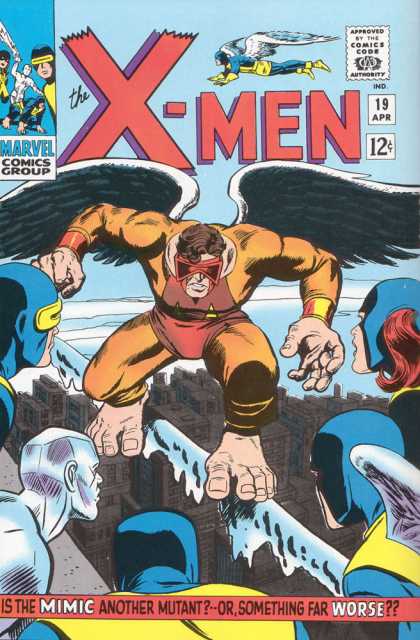
Fun Fact: Mimic was the first new member of the X-Men. Of all the dozens of characters who have been X-Men over the years, Mimic was the first one to join the team after the original five. His membership lasted three issues.

Original costume. He has retained the powers of the first five.
Unlike the first two characters on this list, I don’t really personally identify with the Mimic. He started out as an arrogant hot-head who got his super powers due to an accident in his father’s lab. When he discovered the X-Men, he first tried to fight them. He lost. Shortly thereafter, he came back and joined them instead. For three issues, he was a member of the X-Men and helped them out on some adventures – until Professor X kicked him out for his arrogance. He lost his powers and went away, having learned a lesson about his attitude.
That’s where I first met the Mimic, in his original appearances with the X-Men. My father has an extensive comic book collection, but I never got to read any of the books he has in good condition. I got to read the old beat up issues, which were torn and rarely had their covers in tact. So my love of the Mimic comes from these early issues, some of the first comics I ever read. It’s also why I have a special place in my geeky heart for the original five X-Men. That’s essentially why I love the Mimic. He was one of my earliest comic book reading experiences, with a cool power and he’s made so few appearances over the years that it’s like a game of hide and seek trying to find him in a comic.

It always helps to introduce yourself
After his brief membership with the X-Men, Mimic dropped off the grid for a few years. He popped up a few times in a few random issues. He even died when he copied the gamma radiation powers of the Incredible Hulk…only to come back to life when his corpse copied the healing powers of Wolverine. I wouldn’t know, I’ve never read those issues and only learned about them after the fact.
I re-discovered Mimic in the mid-90s, once my brother and I had started reading more and more comics on our own. I remember it like it was yesterday, in a Media Play store in some mall in Syracuse. I was reading some comics at the rack when my dad walked up and saw the Mimic on the cover of X-Force #46. He pointed him out and I, in a fit of nostalgia for those original X-Men issues, bought the comic. It was pretty fun, revealing that Mimic had been in meditation in Siberia because his powers were out of control. He fought off X-Force, and then went on to become a bit player in the big Event Comic of the summer the Onslaught Saga.
Over the next few years, Mimic kept popping up in various issues for various reasons. He was no longer an arrogant prick. He’d become quite humble, but always managed to find himself teaming up with bad guys. He was a nice guy who kept getting stuck in bad situations. He joined a version of the Brotherhood of Mutants for awhile. I can still remember searching comic book shop back issues for all the various Mimic appearances. It really was like a game there were so few.
Then in 2010, they brought him back yet again and for a new role in the Dark X-Men.

Updated and clean-shaven
The story was Dark Reign, a company-wide Event in which one of the big bad guys in the Marvel Universe had tricked everyone into letting him be in power. He got a bunch of his super villain buddies to pose as the Avengers, making them the Dark Avengers. Then when this baddie went up against the X-Men, he formed his own team to pose as the X-Men. Mimic got plucked from obscurity to be on the Dark X-Men, and it was a blast. Mimic had been tricked just like everyone else, so he believed the baddie was a legitimate hero, and he believed he was doing good as a member of the X-Men. But once again he’d been tricked into joining a villain team.
Along with the X-Men storyline, the Dark X-Men later got their own 5-issue mini-series. Both stories explored Mimic’s character a bit more, and diagnosed him as bi-polar. So he was finally getting some much needed characterization. I really enjoyed reading him in modern adventures, with an actual starring role, even if it was brief. After the end of Dark X-Men, the big baddie was eventually figured out and defeated. The usual good guys were put back in charge and Mimic has once again disappeared into obscurity.
My fingers are definitely crossed that he’ll be back again before too long.
But until then, I have a special memento of the Mimic to enjoy. My girlfriend Alyssa managed to find a copy of his very first appearance, X-Men #19 from the 60s, and she gave it to me for Christmas! I have it bagged and framed on my wall. Am I a lucky geek or what?
4. Phil Urich, the Green Goblin/Hobgoblin
Phil is my Peter Parker. Which was probably the entire point behind his creation in the 90s, when I was just getting into comics. He was the young white guy superhero, created to appeal to the 90s youth culture just like teen-age Peter Parker, Spider-Man, was in the 60s. And it worked on me! Phil was a total slacker with a good heart. He loved video games, made pop culture references and got into superheroics mostly just for the fun of it. He was also broke, something of a loser and wasn’t very good with the ladies.
What’s not to love?

Badass and heroic!
Most people know from the movies that the Green Goblin is Norman Osborne, and is Spider-Man’s greatest foe. Well in comics back in the 90s, Norman and his son Harry had been dead for years. There was no Green Goblin anymore. So writer Tom Defalco came up with the idea that this slacker kid, Phil, would stumble upon one of Norman’s hidden hideouts where he kept a lot of his Goblin Gear. Phil found the costume, the weaponry and even one of those Goblin Gliders, like Norman had in the first movie. A combination of Goblin Serum and Electronics woven into his mask gave Phil super powers and a hypersonic laughter attack. He helped save his uncle from some hoodlums in the first issue, and then went on fighting various super villains and having adventures over the next 12 issues. It was simple stuff, written for the time, but I was hooked. And the art was amazing!
They say that every comic book is somebody’s first, and Phil Urich’s Green Goblin series was the first series I ever collected on my own. I used my own money to buy the single issues back when they were sold in supermarkets. That was back before I even knew that comics came out on Wednesdays. I just sort of lucked into finding all the issues as they came out, and then scoured the back-issue bins to get the rest. And then it wasn’t until I’d graduated college before I was able to find a copy of the final issue, #13, online. I waited years between reading #12 and #13, and it was a blast to jump back in to read Phil’s final issue. The fun was still there.
At the end of the series, Phil’s Goblin Gear was damaged beyond repair and he had to retire. His series was cancelled and he was hurled into the ether of the Marvel Universe. He popped up now and then as a bit player in some Spider-Man comics, but that was for the most part. He had a big role in Spider-Girl, but that series took place in the future, where Phil was an adult. I wasn’t that interested.
Phil finally returned for good in a story in Runaways in the mid-00s. He was still powerless, and was trying to lead a support group for other mid-90s youthful superheroes who, like him, had found themselves cast on the wayside. It was a fun little cameo, and I loved it. The support group went on to star in their own mini-series called The Loners, and I loved that as well. But it was there that Phil began to take a turn for the worst. By the end of The Loners, he was revealed to be the villain because the Goblin Serum had turned him as crazy as it had done Norman Osborne. He fled the group is disgrace, only to return earlier this year in Amazing Spider-Man.

Badass and villainous!
Under the pen of Dan Slott, Phil was still a slacker working for his uncle at the Daily Bugle. This time, Phil took over the identity of the Hobgoblin, and became a villainous mob enforcer! But rather than get beat up and thrown in jail right off the bat, Slott is building up Phil as a longer-lasting villain. He defeated Spider-Man and got away, and is still working at the Daily Bugle without anyone being the wiser. In fact, he’s started taking pictures and video of himself as the Hobgoblin to sell to the Daily Bugle.
Sound familiar?
We’ll see where Phil’s career as the Hobgoblin goes from here. I’m excited to have him so prominently in comics again, but am saddened in a geeky way that he has to be a crazy villain. That never ends well.
5. Tim Drake
This one is a bit of a cheat, because Tim Drake was the third Robin. And like I said, I like the mantle of Robin more than any of the specific people behind the mask. However, Tim Drake is such an awesome Robin that he’s one of my favorite characters anyway.

In the shadow of the Batman
I’ve already written – at length – about why I like Robin, so we’ll skip that part here. Out of all of the Robins, Tim is the best at the job, and that’s a large part in why he’s one of my favorite characters. When reading comics about Batman and Robin, I want Tim Drake as my Robin. So goody for me that the makers of Batman: Arkham City are going to have Tim Drake as their Robin! I can’t wait for that game.
Readers were sick of Jason Todd by the late 80s. He was something of a brat. There was a contest held where readers could call a 900-number and vote to either have Todd killed in a story or have him survive. The readers voted to kill him. But the writers at DC knew that Batman needed a Robin, so they set about creating one for the 90s. Tim Drake was in his low teens (not a young kid), and he was friendly, a bit nerdy, was great with computers and had a lot of heart. Sounds like me! They designed a new, more modern costume for Robin (goodbye pixie boots!) and they started him off with some of his own books. Tim Drake was the first Robin to get his own series, starting with mini-series before leading to his own ongoing title.
My dad bought me the second mini-series in collected for, and that was one of my first direct experiences with Tim Drake. The story was about Tim’s first time protecting Gotham City solo while Batman is out of the country, and he just so happens to have to face off against the Joker. So right off the bat Tim has to prove that he has the chops to figure out the Joker’s scheme and put it to an end, all the while trying to convince both himself and everyone around him that he’s got what it takes to do this job. There are a few great scenes between Robin and Commissioner Gordon where Tim has to defend his abilities.
“They didn’t pick my name out of a hat for this,” Robin tells Gordon. I loved that scene!
So the dorky, friendly Tim Drake really struck a chord with me. Not only that, but he worked great as Batman’s partner! He wasn’t a brat, like Jason Todd, and he wasn’t butting heads with Batman like Dick Grayson. Tim served his duties as Robin wonderfully, providing the support and backup that Batman needs. He was the perfect sidekick to Batman, and that’s why I loved him. But as I said earlier, Tim got ousted from his role as Robin to make way for Damian Wayne. So what did Tim do?
He became Red Robin.

From Robin to Red Robin
The Red Robin codename originally comes from a story set in an alternate future that really has nothing to do with the normal DC universe. Then through some very complicated stories and a visit to an even different alternate reality, a version of the costume found its way back to the normal DCU and into the hands of Tim Drake. When Bruce Wayne was believed to be dead, and Dick Grayson and Damian Wayne took over as Batman and Robin, Tim was the only person in the world who believed that Bruce was still alive (and Tim was right). So since he was no longer Robin, Tim just put on the new costume and the name Red Robin. And eventually he proved his theory right and Bruce came back, but Tim was stuck as Red Robin.
I’m not a big fan of the change. Tim should have stayed Robin. Granted he’d probably achieved everything there was to achieve as Robin, and it was time for him to grow and change as a character, but as I’ve said, I liked him as Robin. Fortunately, the writers at DC found a loophole. He didn’t simply design his own new identity, like Dick did as Nightwing. Tim simply became a more adult version of Robin, keeping the name ‘Robin’ in his new identity. Then when Bruce came back as Batman, Tim has worked with him again as Red Robin. There have been a lot of fun scenes where Bruce and Tim continue their partnership from before Bruce died. It’s been fun.
But come the changes in September, Bruce is going to take Damian as his Robin. Tim will stay as Red Robin, and he’ll be transferred full-time to the Teen Titans. He will still technically be part of the Bat-verse, but his main focus will be the Titans. I suppose we’ll see how that works out.
6. The Spot
The highest-ranking, full-on super-villain on my list is possibly the dorkiest, silliest super-villain in comics. He was once on a team called the Legion of Losers (though they called themselves the Spider-Man Revenge Squad). But you can keep your Dr. Dooms, your Jokers and your Magnetos – I love the Spot. He’s just plain neat.

Take that, Spider-Man!
Check out that costume and that power! The Spot’s body is all white, with little block spots covering him. Those spots are portals. He can throw them around a room or hang them in midair. Go in one and you come out the other. He’s like a living, breathing game of Portal! And honestly, that’s where my love of the Spot comes from. He’s just neat. I suppose I like that he’s a huge dork, and something of a science nerd, but he doesn’t have much character beyond that. The Spot has made fewer appearance than the Mimic, though just like the Mimic, he recently got a modern update. They’ve made him more badass, something of a silent killer who uses his powers as an assassin. That’s pretty cool.
I had a hard time picking No. 6 on this list. I knew the top five, and their order, but I couldn’t decide on No. 6 for the longest time. The Spot was chosen on the criteria that should he appear in a comic, I try to make sure I buy it. He had a fun episode of the 90s Spider-Man cartoon show. And I even tracked down one of his earliest comic book appearance and bought that issue. He’s just a character I enjoy, moreso than other characters. Thanks to Alyssa for suggesting him as No. 6.
Honorable mentions: Stilt-Man, The Shocker, Mach V, Scorpion, the Slingers, Strong Guy, Iceman, Blob, Toad, Avalanche, Green Lantern Corps, Blue Lantern Corps, Batman, Spider-Man, Scarlet Spider, Beta Ray Bill, Silver Surfer.
The X-Men Meet The Office
So apparently there’s a new cartoon version of Mad TV (or something) on Cartoon Network. What little I’ve seen of it is very cheesy, as is this mash-up between The Office and the X-Men. Two great things that go great together, like chocolate and peanut butter. But not really. This video is more cheesy than funny, but definitely geeky.
I No Longer Fear for Marvel’s ‘Fear Itself’
This is the first comic book review on my blog, and I hope to do more in the future. I used to write comic reviews for a website called www.mutanthigh.com back when I was in college, but the workload became too much after graduation and I sort of just faded away. I haven’t yet figured out how I’m going to do comic reviews. New comics come out every Wednesday, but I don’t always buy them that day. I also never have the time to read a whole stack of new comics Wednesday evening to get reviews up in a timely manner. At any rate, we’ll see.
For those who don’t know, writing comic books is my dream job.
Some people want to be rock stars, some movie stars, sports stars, reality TV stars, janitors – I want to write comic books for a living. But like all these dream jobs, you don’t just jump in and get to do it. You’ve got to work hard towards the dream and hope you catch a big break. This blog is part of my journey, which is why I want to include more comics content.
And I think it’s a good enough place as any to start by reviewing issue #4 of Marvel’s Summer event ‘Fear Itself’.

The weird white-haired guy on the left is Marvel's Dracula. Marvel is head over heels in love with the vampire craze, and are trying desperately to make Dracula relevant - they are failing.
I’m sure that most people who read this blog know about comic books in general. Every month, new issues of your favorite superhero comic hit the stands telling stories about Spider-Man, Batman, Captain America, etc. Well, along with those usual titles, the big companies also put out Event Comics, which are basically the stories where everybody has to team up to take on an even bigger threat. These Event Comics sell really well, and Marvel and DC have been churning them out over the past few years. A writer comes up with a big idea and gets to tell one story in the main mini-series, while other writers tackle tie-in comics to tell the side stories. I assume a lot of people out there buy the main mini-series and a lot o the tie-ins.
I don’t. I gave up on tie-ins a few Events back. Most of the time they’re just not interesting.
Fear Itself is a 7-issue story written by Matt Fraction and drawn by Stuart Immonen, both very big creators in this day and age. I actually got to meet Fraction once at a comic book convention. He signed a free comic for me and I got to ask him why he used The Mimic (one of my favorite obscure characters) in a big X-Men adventure he wrote. Cool story all around.
Fear Itself is about a villain called The Serpent, and it’s based a lot in the Thor side of the Marvel Universe. Hopefully you all saw the movie this Spring, or at least read my review. At any rate, the Nazis have uncovered a long lost Norse hammer frozen in the depths of Antarctica for centuries. Head Nazi Sin, the daughter of the Red Skull, uses that hammer to awaken The Serpent from his prison at the bottom of the Atlantic Ocean, where Norse All-Father Odin imprisoned him centuries ago. The Serpent then called upon 7 other long lost hammers to fall to Earth, transforming 7 Marvel Universe heroes and villains into avatars of his destructive power. These avatars have been raining mayhem down upon the world, spreading fear and empowering The Serpent. Marvel’s heroes have fought back valiantly but with futility so far.

Some of the 7 Worthy: Hulk, Juggernaut and Grey Gargoyle. Juggernaut, by far, looks the coolest and creepiest. He should keep this look after the event. Those bug eyes are awesome!
In issue #4, The Serpent has achieved enough world-wide fear as to reawaken his long dormant castle and make himself younger and stronger in the process. Meanwhile, Steve Rogers reclaims his role as Captain America and starts rallying he troops.
So far, Fear Itself has been very underwhelming. I remember putting down issue #3 last month and feeling very ‘ho-hum’ about it. Even though the issue ended with the lead Nazi Sin (now known as the avatar Skadi) killing the new Captain America, Bucky Barnes.

Poor Bucky...he's only been back from his previous dead for a few years now.
There have been a lot of big set pieces in the series so far, but they’ve been rather dull. It’s all a very basic show, with Fraction glossing over the big events rather than getting into the nitty gritty that would actually make the series great. Once The Serpent awoke, Sin led an army of giant Nazi robots to attack Washington DC. There were big splash page pictures of DC landmarks being destroyed. And Nazi Robots! But all we get are the pictures. We don’t see anybody reacting to the Capitol being blown up. We don’t feel the world shaking beneath the might of The Serpent.
We don’t feel the story – and that’s why it’s been dull so far.

The Serpent: old, but not yet very interesting.
Now, in theory, a lot of the reactions might be happening in the tie-ins. I’m sure a lot of those stories are getting into the more human aspects of the story while the main mini-series handles the big events. But I just don’t care. I’m not going to waste money on tie-ins about Speedball or the Black Widow. I buy comics, first and foremost, based on the characters. If there were a Multiple Man or Mimic tie-in, I’d buy that in a heart beat. But I’m not going to buy the Avengers Academy tie-in just to get a fuller version of Fear Itself. Besides, Marvel are always claiming that you don’t need to read the tie-ins to get a full story. The main mini-series should be enough.
But it hasn’t been so far. The story is pretty weird. Basically a new bad guy shows up, and his gimmick is giving a bunch of people their own version of Thor’s hammer. But this just turns them into mindless, rampaging brutes. When the Hulk got his hammer, there was a brief moment where he seemed to fight for control, and that could have been cool, but he soon gave in. I’d like to see the Hulk – the STRONGEST ONE THERE IS! – actually be able to shake off The Serpent’s control. But that hasn’t happened yet. The main series just shows a bunch of rampaging avatars, and it’s boring. We comic fans see rampaging super villains all the time. Not to mention that Norse hammers have a special purpose that is perverted by this story. Thor’s hammer, Mjolnir, was specially crafted for him by Dwarven forgers. The Serpent suddenly being able to call on 7 magic hammers, as if everybody in Norse mythology uses hammers, takes away from the uniqueness of Thor’s hammer. So if everybody has special hammer, then nobody’s hammer is special. Everything becomes generic.
What makes a good story great is showing us the human reaction, the heart.
Fear Itself has not yet shown us the heart.
But they try in issue #4. Like I said, this is where Captain America starts rallying the troops. You may all recall the news story a few years ago where Captain America was killed. He wasn’t really, but everybody thought he was for about two years. Then he came back, but by then his old sidekick Bucky had taken over the Cap identity. So Steve Rogers stepped aside to be his own hero and let Bucky stay as Cap. But with Bucky dead, Steve puts on his old costume and becomes Captain America again in this issue.
But there’s no fanfare!
We don’t even see Cap standing over the body of his dead friend and promising him justice! We just see Cap already in costume sitting with his head down. Then the others come up to him and tell him it’s time to get going. None of the characters seem to care that Steve is Cap again, so why should I care? It’s cool that he jumps right back into the leadership role, and that provides a little heart. He gets Thor and Iron Man together and they each head off to take on a different aspect of the threat. Cap goes to join the Avengers in protecting New York City, Iron Man goes to try and reason with Odin and Thor goes to confront The Serpent head-on. We get a little bit more backstory about The Serpent, but not enough to make us care yet.
So issue #4 starts to put Fear Itself back on track. The first three issues were dull in that they were just mindless action for the sake of action. It was all build-up as the threats started getting worse, but they only showed us these threats in the most basic, glossed over sense. Sure some buildings blew up, some faceless extras got wiped out and a hero died, but so what? We’ve seen it all before. Some hero being sacrificed to give an Event Comic more depth has become cliche. Blowing up monuments no longer has any impact. And the villains just aren’t that interesting yet.

Sin as Skadi may look cool, but she's little more than just 'bad guy'.
But with the heroes coming together in issue #4, we’re finally seeing some more character-specific actions. That’s what I want to read about. Big fights, like the one teased at he end of this issue, aren’t as interesting if we don’t care about the characters involved. So let’s hope the next three issues of Fear Itself have more heart than mindless violence.

 Henchman-4-Hire