Review: The Ray #1
I can only assume that The Ray was a rejected idea for the New 52 back in September. Coming so soon after the big reboot, and resigned to just a mini-series, I imagine that some editor somewhere liked the idea enough to give it a lifeline. Which is fine. I’ll never oppose adding more comics to the shelf. But The Ray #1 is so bland, mediocre and generic that I can see why it was rejected. The book lacks a hook, lacks any creative or interesting idea to make it worthwhile.
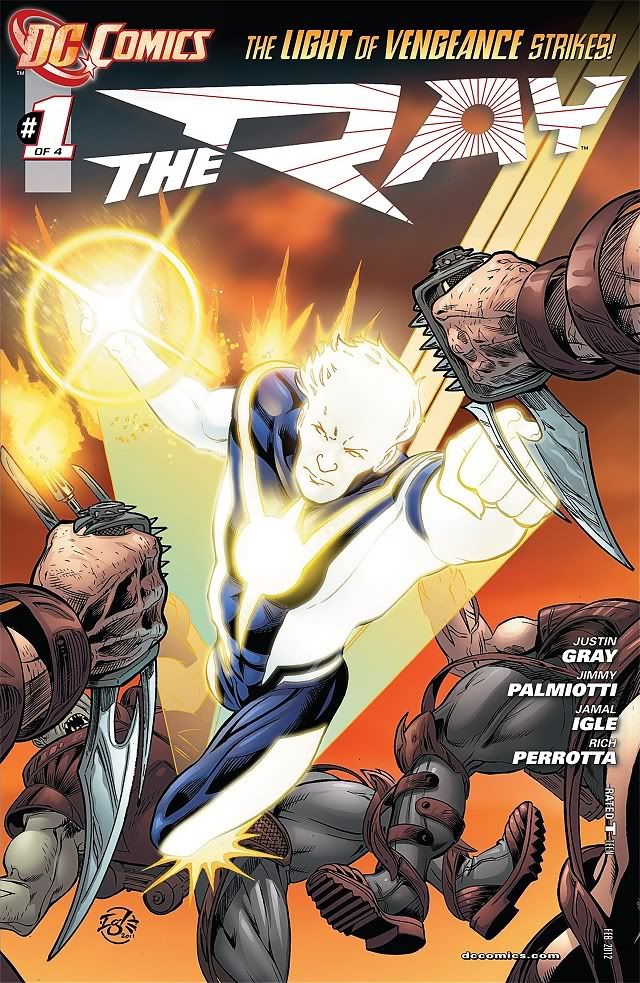
The Ray #1
So if you like your superheroes ordinary and plain, The Ray is the book for you.
Comic rating: 3/5: Alright.
That’s not to say The Ray is a bad read. It’s a perfectly fine comic book about a brand new superhero and his origin story. Though the concept isn’t new. The character of ‘the Ray’ has been around since 1940, and DC had a C-list character running around with his own series back in the 90s and up until the New 52 reboot. For this story, though, writers Justin Gray and Jimmy Palmiotti are starting from scratch. The light-based powers are the same, but we’ve got a new hero, a new supporting cast, a new status quo and new villains. Unfortunately, Gray and Palmiotti did little to capture my attention.
I picked up The Ray #1 on a whim. I like the costume, it was a light comics buying week and I thought ‘what the heck?’. While I’m not disappointed that I bought the comic, I don’t know if I’ll buy anymore. The Ray just isn’t a very bright idea.
Spoilers after the jump.
We open with a full page view of the new Ray fighting a swarm of giant, telepathic, monstrous jellyfish in San Diego. This is a very wordy book, with a constant inner monologue coming from its star, Lucien Gates. Right away he tells us that he’s Korean-American, he mentions the original Ray and he comments on the silliness of the jellyfish. He’s affable, friendly and speaks with a relaxed tone.
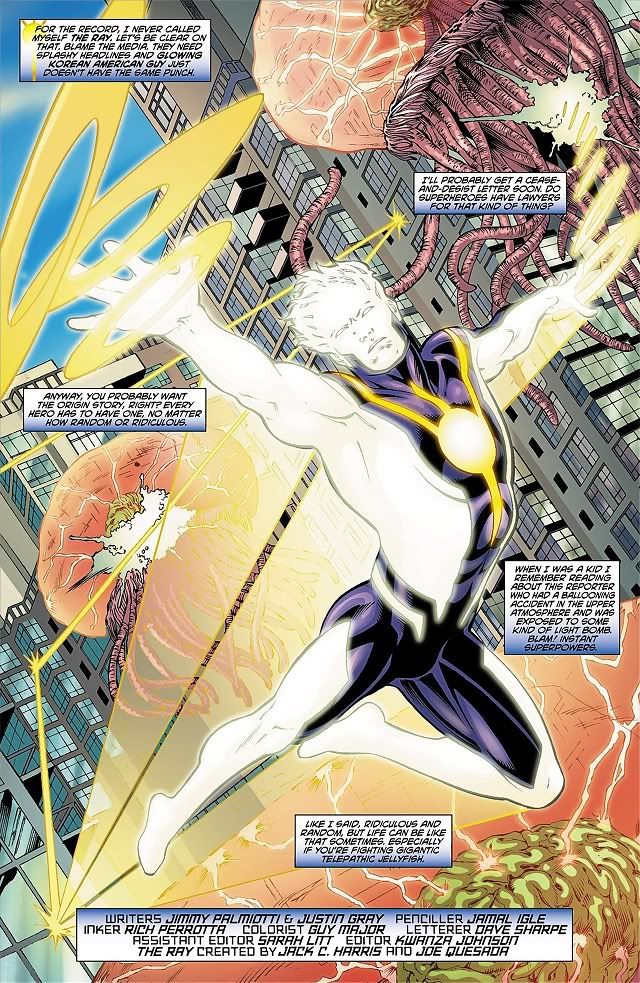
Seen but not heard, Ray
Honestly, he seems like a nice enough guy. There are absolutely no bad things to say about Lucien. He makes bad jokes, but I’m not sure if that’s an intentional character trait or if the writers think they’re good jokes. Mostly they’re just bland jokes.
I like the costume. It’s one of the main reasons I picked up the book. So it’s a nice opening page. The Ray definitely has a good look. Here’s what the old Ray looked like, for comparison:
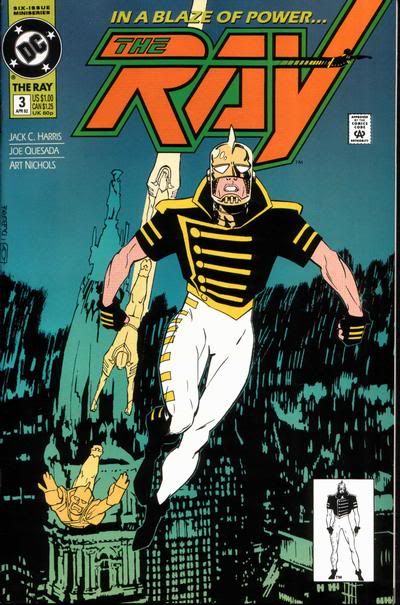
Jackets are always classy
But we’ll talk more about the costume later, when it becomes an issue. The fact that he’s a Korean-American, and the fact that he mentions it in the very first narration box, means that diversity was a big part of his creation.
The problem is that it doesn’t matter that he’s a Korean-American, or that he’s the Ray. This issue, this origin story and this comic book could be told with any ethnicity and any character and still be the exact same. They may as well have been telling the origin of a new Human Bomb or Black Condor as much as the Ray.
At any rate, this is Lucien:
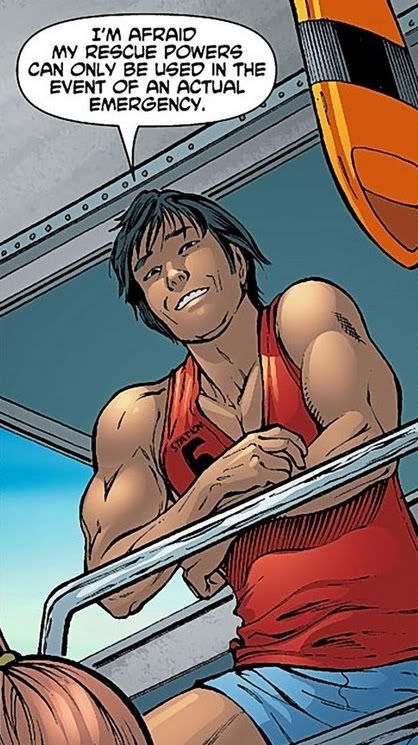
But I'm sure he can be persuaded to give you beach babes CPR
He’s a buff, fit and friendly life guard whom all the ladies love. In short order, we meet his best friend Darius Williams, son of a famous record producer, and we get his origin story. Remember the Large Hadron Collider? The big science machine out in Europe that everyone was afraid would destroy the world when it was turned on? Well we get something similar called a ‘Sun Gun’, basically just a big military experiment/superpowers-giving device. It goes off by accident and the ray hits Lucien, turning him into the Ray.
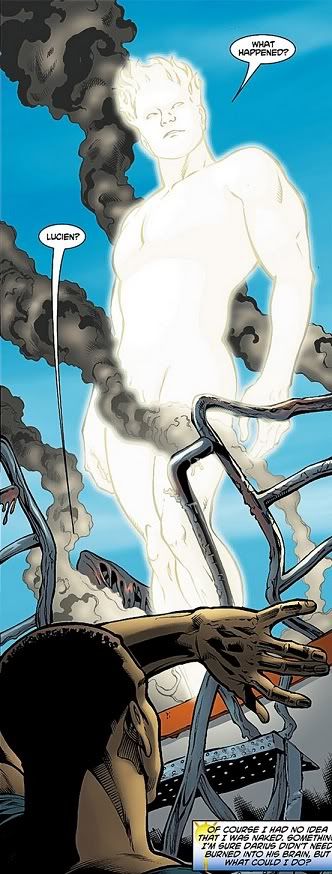
Everybody can see his bright, shining penis
It’s a suitable origin story, if largely uninteresting. The hook might be that he’s naked all the time. Some cheesecake for the female comic book readers, perhaps? I did write that article on how DC seems to be using sex and nudity way too much.
So the Ray doesn’t fly, he bounces around at the speed of light. And since he just got his powers, he’s out of control, bouncing against buildings and airplanes and more across hundreds of miles in the blink of an eye. Eventually he’s able to clam himself down and crashes on a beach in Seattle. Then there’s some naked humor.
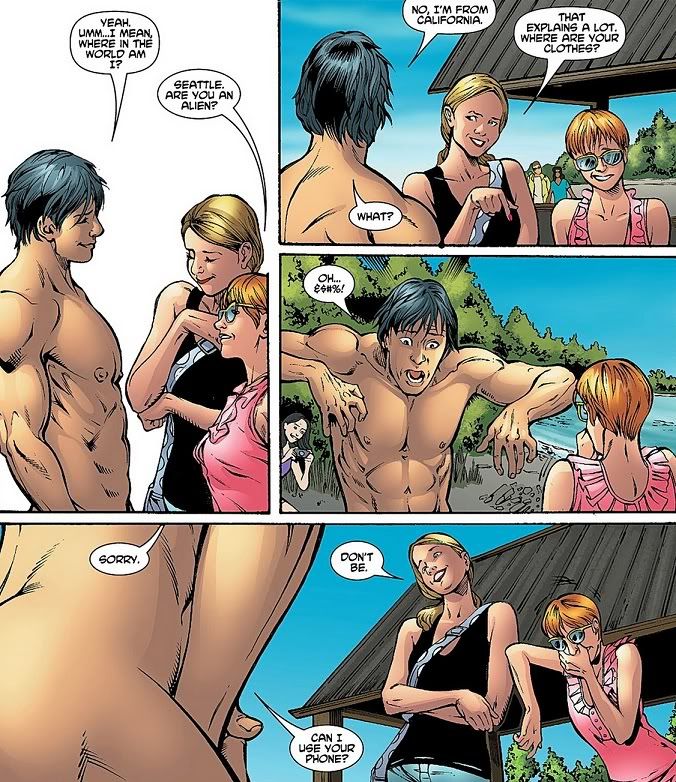
The ladies love him, all of him
Lucien calls his buddy Darius and recounts his wild adventure. Then we get the first of the plot jumps: Lucien says that his mind moves at the speed of light now too. So he quickly figures out that he was “riding light and reflections” and is able to just zip back home to San Diego.
This is a problem. Starting with this ‘explanation’, we’ll see a lot of times in this issue where Ray’s light-based powers are able to accomplish anything they need to. Ray might as well be magic. Lucien also just shrugs it off as him doing research into light, or something. I’ll point them out when we get to them. But his powers become a literal dues ex machina, capable of doing whatever he might need with only a half-hearted bit of pseudo-science to explain it away.
For example, his new light body burns his clothing away. That’s why he’s always naked.
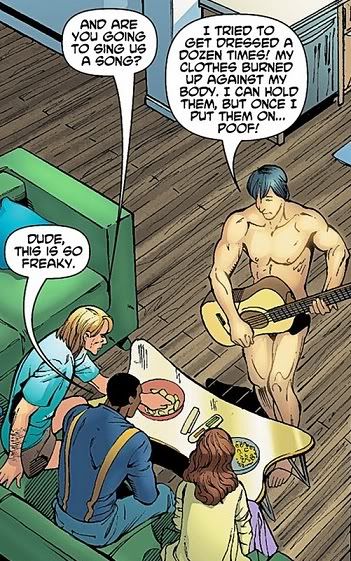
The Naked Cowboy wants his shtick back
He reveals himself to his parents and Darius without hesitation. So at least he’s not keeping his secret identity from his family. That’s something, I guess. His parents are white, so we assume Lucien was adopted. His parents are also uber-hippies who grow their own food and make their own clothes, yet still look beautiful and live in a nice house in San Diego. So take that what you will. His parents fit into easily programmable roles.
We cut back to Ray fighting the jellyfish, which obviously occurs sometime after his origin. He explains to us via narration that we’re just going to skip the superhero origin montage. So there’s a little fourth-wall breaking. He simply tells the reader that he went through that early stage of not using his powers correctly and making himself out to be an idiot. Now he’s the kind of guy who can successfully fight off an army of monstrous jellyfish.
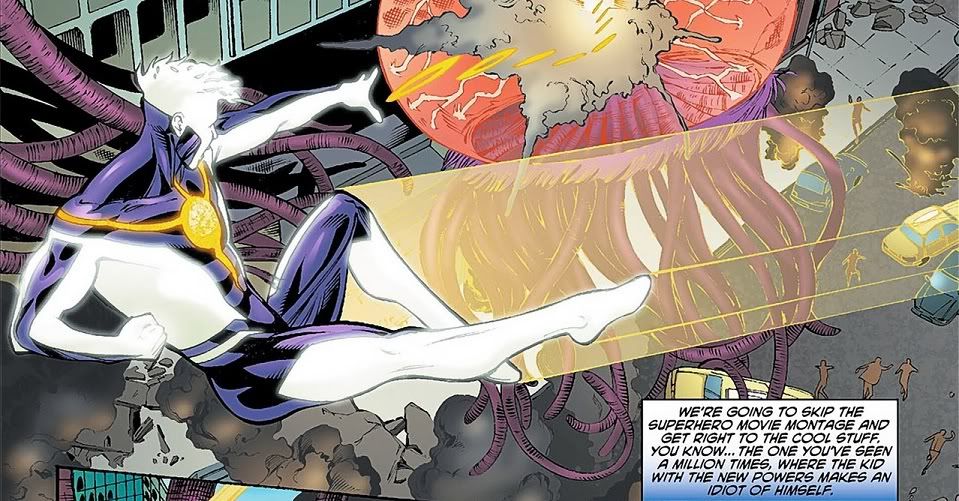
Still looking good, Ray
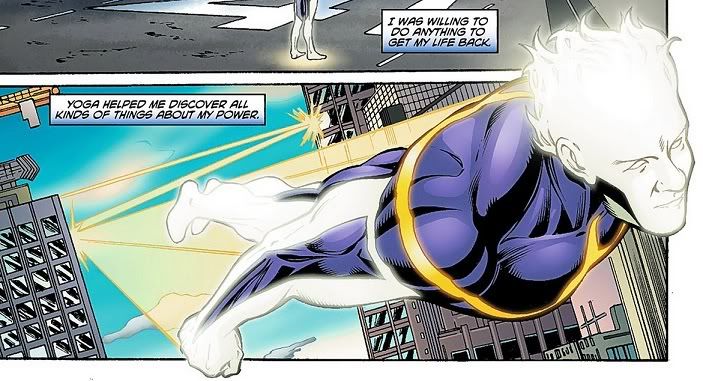
He also explains, rather than show us, that he figured out how to bend the light of his body to make it appear as if he’s wearing clothes. He tells the audience that he did research into the nature of light and figured out how to use his powers to make people see whatever he wants. It still means he’s naked all the time though.
This is a shame, because seeing a new hero get used to his powers is usually a good story. Instead, we jump past all that interesting, character-building stuff and go right to where he’s a bona fide superhero. I would have liked to see how and why he designed his costume the way he did. But apparently none of that is interesting.
Also, we miss any parts that would tie the Ray into the new status quo of the DC comics universe. Wasn’t the world supposed to be less hesitant in trusting or liking superheroes? We get no sense of that. This character and origin story could have happened pre-reboot. Or it could have happened in Marvel Comics or Image Comics or in the back of some kid’s notebook at school. It’s that generic.
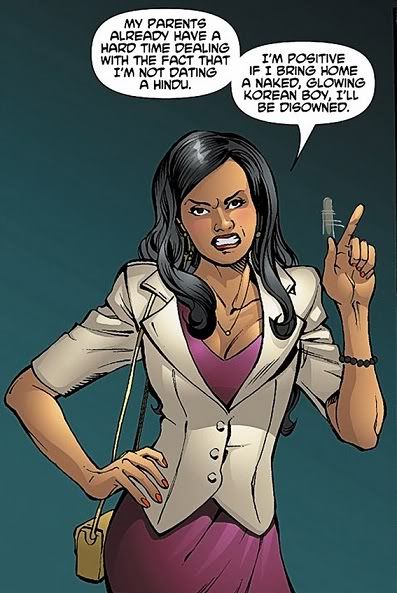
Anyway, next we meet Lucien’s girlfriend Chanti. She’s a hot, tough-as-nails Indian babe.
Priorities, woman!
Lucien doesn’t hesitate in telling her all about his powers either, though he did avoid her for a few days after getting his powers. But that was more about learning about the powers than actually avoiding her. Chanti is totally cool and unphased by the powers, more concerned with how her parents will react to her weird boyfriend. She wants Lucien to see a doctor…we don’t know if he ever did.
Another missed opportunity with the girlfriend. Lucien is already head over heals in love with her, and she with him. So there’s no tension or romance involved in trying to win the girl of his dreams with his new super powers. That part is kind of a cliche, I suppose, but it’s far more interesting than him already being in a loving, accepting relationship with a girl who is totally fine with his powers. And again, like Darius and Lucien’s parents, Chanti is a nice, friendly, bland sort of person.
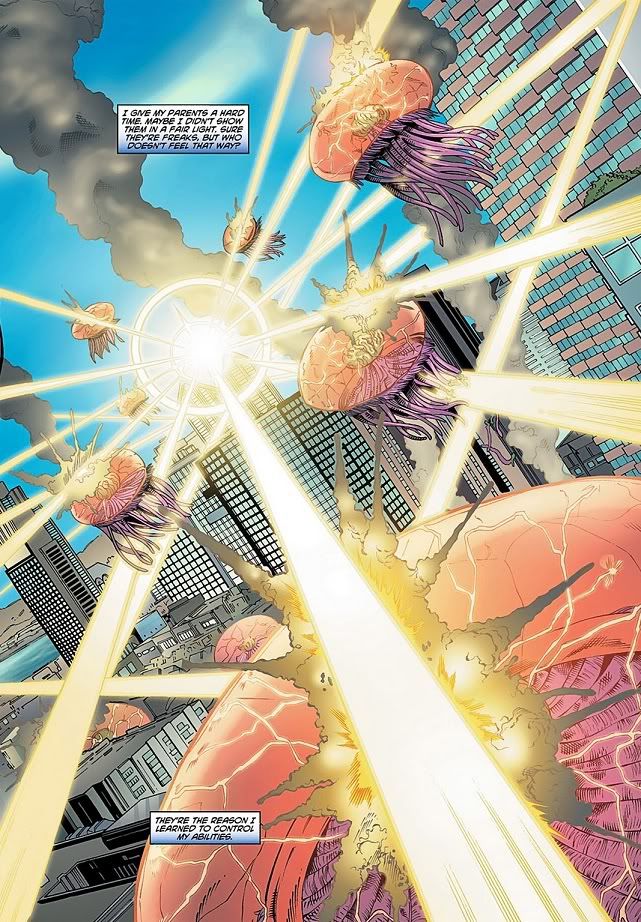
Back at the jellyfish fight, the Ray has the big idea to shine his light through a big glass skyscraper, sending beams of light everywhere and I guess stopping the jellyfish. He makes a point to mention that he doesn’t want to kill them, just get them out of San Diego.
Jellyfish hate light
And that works. There’s a panel with the jellyfish just sort of flying away after that, with the Ray looking on. He doesn’t tell us how it worked, it just does. Ray’s too busy telling the reader how he’s getting used to his powers and learning all about them. Like how he can hover. His parents got him to do yoga to balance his inner light, so there’s another ‘magic’ way he can just use his powers.
The world needed more yoga-based superheroes
We end with him recapping that he’s still got a girlfriend, still got his best friend and he’s still got his job as a lifeguard. Zippedy-doo-da!
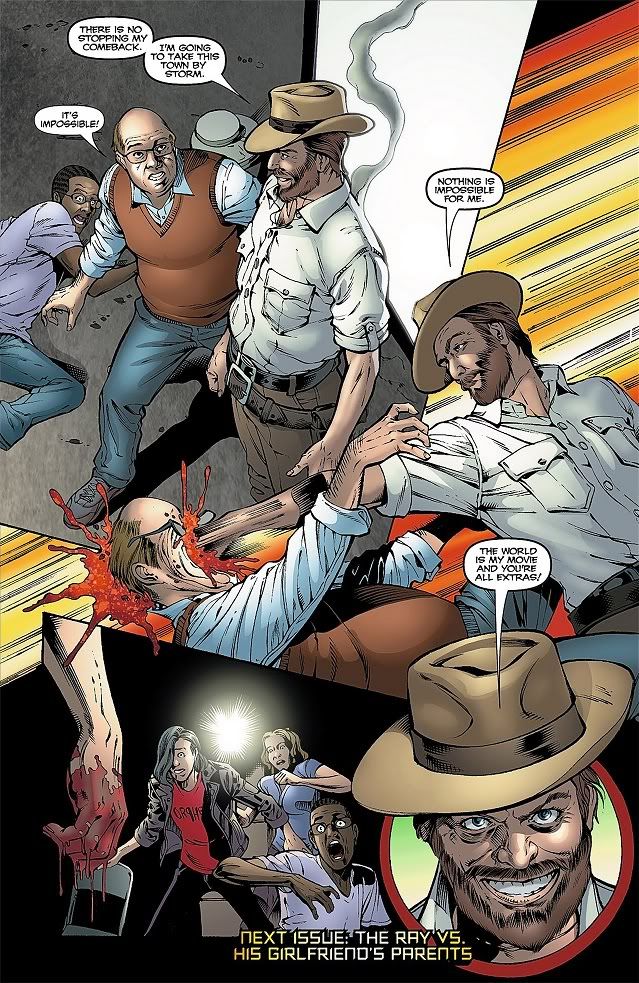
Actually, the real ending is a brief introduction to our villain, rebel filmmaker Thaddeus Filmore. We’re once again told Filmore’s origin, rather than being shown, unless you count the little flashback panels. Basically a film professor is showing his students the never-before-seen footage of Filmore’s death. He was a rogue documentary filmmaker who loved to film human suffering. So clearly he’s a psycho.
Filmore’s journeys took him to some remote tribal village, where he went to investigate a Lazarus Pit, so woot callback to Batman and Ra’s al Ghul. The footage shows Filmore getting his neck slit by the tribespeople and then thrown into the Pit.
Somehow, not only does this revive him, but it apparently trapped him into the film. Because while the people are watching it, Filmore somehow comes through the screen and materializes in the room with them. Then he punches and kills the film professor, because why the hell not.
LAZARUS PITS DO NOT WORK THAT WAY!!
As for that ‘Next Issue’ blurb at the end, I approve. I’m definitely more interested in Lucien having dinner with his girlfriend’s parents over fighting this guy Filmore. It’s called character growth.
So yeah, that’s the Ray. He’s a nice guy who accidentally got some super powers. But rather than worrying about them or having any sort of conflict, he just snaps his fingers and becomes a superhero. Giant, flying, telepathic jellyfish? He just shrugs it off and sends them on their way. Not even weirded out by them. His family, his best friend and his girlfriend are all cool with his powers, so no conflict there. The Ray is just incredibly bland.
There’s nothing unique or interesting about him. He’s just another superhero with generic super powers and a pretty cool costume. He’s a dime a dozen in the world of comics. Lucien is handsome, muscular, has loving parents, a hot girlfriend, a rich best friend and all the ladies love him. His life is fine and is in no way impacted by his becoming a superhero. There is no conflict in this origin story. I wouldn’t be surprised if Superman or Batman shows up in issue #2, because that’s what comic book companies due for the second issue. They throw in a guest star who may drum up sales.
Because it’s clear that The Ray isn’t going to sell all on its own.

Posted on December 17, 2011, in Comics, DC, Reviews and tagged The Ray. Bookmark the permalink. 1 Comment.

 Henchman-4-Hire
Pingback: Review: Phantom Lady and Doll Man #1 « Henchman-4-Hire